
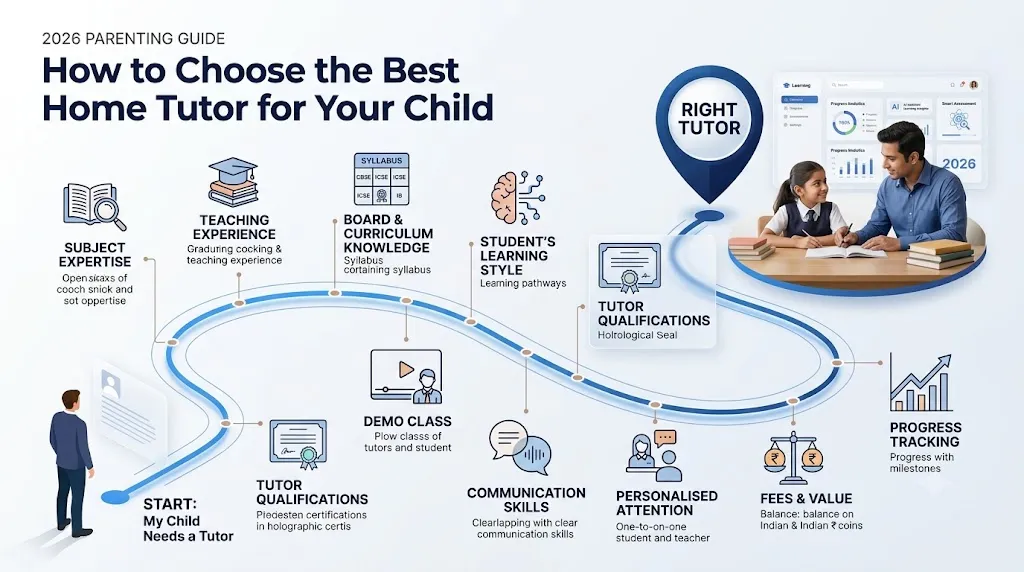
How to Choose the Best Home Tutor for Your Child in 2026: A Complete Parent’s Guide
Finding the right tutor for your child can make a remarkable difference in academic performance, confidence, study habits, and long-term learning. But with so many home tutors, online tutors, coaching institutes, and tuition services available, choosing the right person is not always easy.
A tutor may have excellent academic qualifications but may not be the right fit for your child. Another tutor may have years of experience but use a teaching style that your child finds difficult to follow.
The right home tutor is not simply someone who knows the subject. The right tutor is someone who understands your child's learning needs, explains concepts clearly, adapts to the student's pace, builds confidence, and consistently works toward measurable improvement.
This guide explains exactly what parents should look for when choosing a home tutor in 2026—from qualifications and teaching experience to demo classes, communication, fees, personalised attention, progress tracking, and compatibility.
How to Find the Right Home Tutor for Your Child
Before searching for a tutor, start by identifying why your child needs tuition.
Is your child struggling with Mathematics? Preparing for board examinations? Looking for stronger fundamentals? Preparing for IIT JEE, NEET, NDA or another competitive examination? Or simply looking for a structured study routine and additional academic support?
The answer will determine the type of tutor you should choose.
For example, a student who needs help with Class 8 Mathematics may require a very different tutor from a Class 12 student preparing for IIT JEE Advanced. Similarly, a child who understands concepts but struggles with examination writing may need a different approach from a student whose fundamentals are weak.
A good starting point is to identify these five things:
-
Class and curriculum: CBSE, ICSE, ISC, UP Board or another board
-
Subjects requiring support
-
Current academic level
-
Specific learning difficulties or goals
-
Expected outcome from tuition
Once these are clear, you can begin evaluating tutors more intelligently.
10 Important Factors to Consider Before Choosing a Home Tutor
Choosing a tutor should not be based only on qualifications or tuition fees. Consider the complete picture.
1. Check the Tutor’s Subject Expertise
The first question should be simple: Does the tutor genuinely understand the subject your child needs help with?
A tutor who teaches Mathematics effectively may not necessarily be the best choice for Physics, Chemistry, English or Biology.
For school students, subject expertise should ideally include an understanding of the relevant curriculum, textbooks, examination pattern, assignments and common areas where students struggle.
For competitive-exam preparation, subject expertise becomes even more important.
A student preparing for IIT JEE needs a tutor who understands not only the school syllabus but also the depth, problem-solving approach and examination requirements of JEE preparation.
Similarly, NEET preparation requires strong conceptual knowledge in subjects such as Biology, Physics and Chemistry along with familiarity with the examination pattern.
Look for a tutor whose expertise matches your child's actual academic requirement—not simply someone who is generally described as a “good teacher.”
2. Consider Teaching Experience, Not Just Degrees
Qualifications matter, but qualifications alone do not guarantee effective teaching.
A tutor may have an impressive degree but struggle to explain difficult concepts to a young learner. Conversely, an experienced teacher may be exceptionally good at breaking complex concepts into simple, understandable steps.
When evaluating experience, ask:
-
How many years has the tutor been teaching?
-
Which classes has the tutor taught?
-
Which boards has the tutor worked with?
-
Does the tutor teach the required subject regularly?
-
Has the tutor worked with students at a similar academic level?
-
Does the tutor have experience preparing students for examinations?
For younger students, experience with the relevant age group is particularly important because teaching a child requires patience, communication and the ability to maintain attention.
3. Make Sure the Tutor Understands Your Child’s Board and Curriculum
Different boards can have different syllabi, examination patterns, textbooks and expectations.
If your child studies under CBSE, the tutor should be comfortable with the CBSE curriculum. The same principle applies to ICSE, ISC, UP Board and other educational boards.
This becomes especially important before board examinations.
A tutor who understands the curriculum can help the student with:
-
Chapter-wise concepts
-
Important topics
-
Question-solving techniques
-
Previous examination patterns
-
Written-answer presentation
-
Revision planning
-
Mock tests
-
Time management
For competitive examinations, the tutor should additionally understand how school preparation and competitive preparation can be balanced.
4. Choose a Tutor Who Can Adapt to Your Child’s Learning Style
Every child learns differently.
Some students understand a concept immediately after a visual explanation. Others need examples. Some learn through repeated problem-solving, while others need the underlying theory explained first.
This is one of the biggest advantages of one-to-one tuition.
The tutor can observe how the student learns and adjust the teaching approach accordingly.
For example:
If the student is weak in fundamentals:
The tutor can go back to prerequisite concepts before moving ahead.
If the student understands concepts but makes mistakes:
The tutor can focus more on practice, accuracy and error analysis.
If the student is academically strong:
The tutor can introduce advanced problems instead of spending excessive time on concepts the student has already mastered.
A personalised approach is much more useful than forcing every student through exactly the same lesson plan.
5. Always Consider a Demo or Trial Class
One of the best ways to evaluate a tutor is to actually observe the tutor teaching your child.
A CV can tell you about qualifications and experience. A conversation can tell you about availability and fees. But a demo class can reveal how the tutor actually teaches.
During the demo, observe:
-
Does the tutor explain concepts clearly?
-
Does the tutor ask questions?
-
Does the tutor allow the child to think independently?
-
Does the tutor identify the student's weak areas?
-
Does the tutor use examples appropriately?
-
Does the tutor maintain the child's attention?
-
Does your child feel comfortable asking questions?
-
Does the tutor check whether the student has understood?
Do not focus only on whether the tutor is friendly.
The more important question is:
“Did my child actually understand something better after this session?”
That is a much stronger indicator of teaching effectiveness.
6. Evaluate Communication Skills and Patience
A great tutor should be able to explain the same concept in different ways.
If a student does not understand something the first time, saying it again louder or faster does not solve the problem.
An effective tutor might use:
-
A simpler explanation
-
A real-life example
-
A diagram
-
A different method
-
Step-by-step problem solving
-
Additional practice questions
Patience is particularly important for students who have lost confidence in a subject.
A child who is afraid of making mistakes may stop asking questions. A supportive tutor creates an environment where asking questions becomes part of learning.
7. Look for Genuine One-to-One Attention
Parents often choose private tuition because they want more individual attention than a student may receive in a crowded classroom.
The tutor should therefore spend meaningful time understanding the individual student.
One-to-one tuition can allow the tutor to:
-
Adjust the pace of teaching
-
Revisit difficult concepts
-
Give customised practice
-
Identify recurring mistakes
-
Provide immediate feedback
-
Spend more time on weak topics
-
Move faster through areas the student already understands
This personalised attention can be particularly valuable for students who hesitate to ask questions in a classroom environment.
8. Ask How the Tutor Will Track Progress
A tutor should not simply complete chapters every week.
Completing the syllabus and improving the student are two different things.
Ask the tutor how progress will be measured.
A structured approach may include:
-
Regular assessments
-
Topic-wise tests
-
Homework review
-
Error analysis
-
Revision sessions
-
Mock examinations
-
Performance comparisons
-
Parent feedback
For example, instead of saying:
“Your child is improving.”
A better progress discussion would be:
“The student has improved in algebraic equations but is still making mistakes in word problems. We will spend the next two weeks strengthening that area and reassess the performance.”
That level of specificity helps parents understand whether tuition is actually working.
9. Compare Fees With Value, Not Just Price
Tuition fees can vary significantly depending on several factors.
These may include:
-
Student's class
-
Subject
-
Tutor's qualifications
-
Teaching experience
-
Location
-
Number of classes per week
-
Duration of each class
-
School syllabus
-
Competitive-exam preparation
-
Home versus online tuition
-
Individual versus group learning
The cheapest tutor is not necessarily the most economical choice.
Suppose a low-cost tutor takes many months to address a student's weaknesses, while a more experienced tutor identifies the problem quickly and creates a targeted plan.
The second option may provide significantly greater value.
Instead of asking only:
“How much does the tutor charge?”
also ask:
“What will my child receive for that fee?”
A good tuition arrangement should have clear expectations regarding class frequency, duration, curriculum coverage, assessments and communication with parents.
10. Check Reliability, Safety and Professionalism
For home tuition, parents should also consider practical factors.
Before finalising a tutor, verify:
-
Identity and qualifications
-
Teaching experience
-
References or relevant background
-
Availability
-
Punctuality
-
Professional communication
-
Location and travel feasibility
-
Class schedule
-
Cancellation policy
-
Parent-tutor communication process
For younger students especially, parents should feel comfortable with the tutor's professionalism and overall conduct.
A reliable tutoring arrangement should make the parent feel informed and confident—not uncertain about what is happening in every class.
Should You Choose a Home Tutor or Online Tutor?
Both home tuition and online one-to-one tuition can work extremely well. The better choice depends on the student's personality, learning requirements and family circumstances.
Home Tuition May Be Better When:
-
The child learns better face-to-face.
-
Parents prefer the tutor to visit the home.
-
The student needs close supervision.
-
The child is younger.
-
The student struggles to remain focused during online classes.
-
Practical interaction is important for the subject.
Online One-to-One Tuition May Be Better When:
-
The student is comfortable using technology.
-
You want access to tutors from different cities.
-
Travel time is an issue.
-
The student prefers digital resources.
-
Flexible scheduling is important.
-
You want to continue classes while travelling.
The most important factor is not whether tuition is labelled “home” or “online.”
The real question is whether the student receives personalised, effective and consistent teaching.
What Should Parents Ask a Tutor Before Finalising?
Before making a decision, parents can ask a tutor the following questions:
-
How long have you been teaching this subject?
-
Which classes and boards do you teach?
-
Have you taught students with similar academic challenges?
-
What is your teaching methodology?
-
How will you identify my child's weak areas?
-
Do you conduct regular tests?
-
How will you communicate progress to parents?
-
How many classes do you recommend per week?
-
What will you cover during the first few classes?
-
Do you offer a demo or assessment session?
-
How do you help students prepare for examinations?
-
Do you also teach advanced or competitive-exam concepts if required?
The answers can reveal much more than a tutor's profile alone.
How Many Tuition Classes Does a Student Need?
There is no universal number of classes that works for every student.
A student with strong fundamentals may need only a few focused sessions each week, while a student preparing for board examinations or a competitive examination may require a more intensive schedule.
The right frequency depends on:
-
Current academic level
-
Number of weak subjects
-
Examination timeline
-
School workload
-
Homework requirements
-
Competitive-exam preparation
-
Student's learning speed
Rather than choosing an arbitrary number of classes, start with the student's goals and create a realistic schedule around them.
What Are the Red Flags When Choosing a Tutor?
Parents should be cautious if a tutor:
-
Guarantees a specific percentage or rank without assessing the student.
-
Makes unrealistic promises about results.
-
Cannot clearly explain their teaching experience.
-
Avoids questions about qualifications.
-
Focuses entirely on completing chapters.
-
Does not assess the student's existing knowledge.
-
Refuses to provide any meaningful progress feedback.
-
Frequently cancels or arrives late.
-
Uses the same teaching method for every student.
-
Discourages the child from asking questions.
A professional tutor should be confident about their teaching ability without making unrealistic promises.
Good tutoring creates a process for improvement; it does not guarantee outcomes that depend on many factors.
How Guru Home Tutors Helps Parents Find the Right Tutor
Finding an individual tutor on your own can take considerable time. Parents may have to search profiles, compare qualifications, check availability, discuss fees and determine whether the tutor is suitable for their child's requirements.
Guru Home Tutors helps simplify this process by connecting parents with tutors based on their specific requirements.
Parents can look for tutoring support according to factors such as:
-
Class and grade
-
Subject
-
Board
-
Location
-
Learning requirements
-
Home or online tuition
-
School examination preparation
-
Competitive examination preparation
With a network of tutors across 350+ cities in India, Guru Home Tutors can help families explore suitable tutoring options for different academic requirements.
Whether a student needs support in Mathematics, Science, English, Physics, Chemistry, Biology or another subject, the objective should remain the same: find a tutor whose teaching approach matches the student's needs.
For students preparing for competitive examinations such as IIT JEE, NEET, NDA and other entrance examinations, parents should specifically look for tutors with relevant subject expertise and examination experience.
When Should You Start Home Tuition?
Parents often wait until examination results reveal a problem.
That may not always be necessary.
If a child is regularly struggling with a particular topic, avoiding a subject, falling behind the classroom pace or losing confidence, early academic support can prevent small gaps from becoming larger ones.
At the same time, tuition should not automatically mean more hours of studying.
The goal should be better learning, not simply longer studying.
A well-planned tutor can help a student understand difficult concepts, practise effectively and develop a more organised study routine.
How to Know Whether Your Child Has the Right Tutor
After the first few weeks, look beyond marks alone.
Ask your child:
-
Do you understand the tutor's explanations?
-
Can you ask questions comfortably?
-
Are difficult topics becoming easier?
-
Do you feel more confident?
-
Are you making fewer repeated mistakes?
-
Is the tutor listening to your questions?
-
Do you feel the classes are helping?
Also look for measurable changes.
Perhaps the student is solving problems independently instead of waiting for answers. Maybe homework is becoming more manageable. Perhaps the child has started participating more confidently in school.
These improvements can be early indicators that the tutoring relationship is working.
The Best Tutor Is the Right Tutor for Your Child
There is no single tutor who is perfect for every student.
The best tutor for a child depends on the student's:
-
Academic level
-
Learning style
-
Personality
-
Subject requirements
-
School board
-
Examination goals
-
Learning pace
-
Long-term objectives
That is why parents should avoid choosing a tutor based only on price, qualifications, proximity or a recommendation from someone else.
Instead, evaluate the complete picture.
Subject expertise + teaching experience + compatibility + personalised attention + communication + measurable progress = a stronger tutoring choice.
If your child needs additional academic support, start by identifying the exact requirement. Then find a tutor who can address that requirement with a structured and personalised approach.
Ready to Find the Right Tutor for Your Child?
Finding the right tutor does not have to be a trial-and-error process.
Share your child's class, board, subjects, location and learning requirements with Guru Home Tutors, and explore tutoring options suited to your needs.
Whether you are looking for home tuition, one-to-one online tuition, school subject support, board-examination preparation or competitive-exam guidance, the right tutor can provide your child with the focused attention and personalised support that a crowded classroom may not always offer.
The goal isn't simply to find a tutor. It's to find the right learning partner for your child.
Frequently Asked Questions About Choosing a Home Tutor
How do I choose a good home tutor for my child?
Start by evaluating the tutor's subject expertise, teaching experience, curriculum knowledge, communication skills, teaching methodology and ability to provide personalised attention. A demo class can also help determine whether the tutor is a good fit for your child.
What qualifications should a home tutor have?
The appropriate qualification depends on the student's class and subject. More important than a degree alone are relevant subject knowledge, teaching experience, curriculum familiarity and the ability to explain concepts clearly.
Is a demo class important before hiring a tutor?
Yes. A demo class allows parents and students to evaluate the tutor's teaching style, communication, patience and ability to explain concepts. It also helps determine whether the student's learning style matches the tutor's approach.
How much does a home tutor cost in India?
Home tuition fees vary depending on factors such as class, subject, tutor experience, location, number of classes, session duration and whether the student requires school or competitive-exam preparation. Parents should compare the overall value of the tuition rather than choosing solely on price.
Is home tuition better than coaching classes?
Home tuition can provide personalised one-to-one attention, while coaching classes may provide a structured group learning environment. The better option depends on the student's learning style, academic goals and individual requirements.
Can a home tutor help with board examination preparation?
Yes. A tutor experienced with the relevant board can help students strengthen concepts, practise questions, revise important topics, improve answer-writing skills and prepare for examinations.
Can I find a tutor for IIT JEE or NEET preparation?
Yes. Students preparing for competitive examinations should specifically look for tutors with relevant subject expertise and experience with the examination pattern. The tutor's ability to build strong concepts and develop problem-solving skills is particularly important.
How long does it take to see improvement after starting tuition?
It varies from student to student. Improvement depends on the student's starting level, learning gaps, attendance, practice, teaching quality and examination goals. Regular assessment is a better way to measure progress than expecting an immediate change in marks.
Should I choose a home tutor based on low fees?
Not necessarily. A lower fee does not automatically mean better value. Parents should consider teaching experience, subject expertise, personalised attention, class frequency, progress tracking and the tutor's ability to meet the student's specific needs.
What is the most important factor when choosing a home tutor?
The most important factor is fit. A tutor should have the necessary subject knowledge and experience, but should also be able to communicate effectively with your child, adapt to their learning needs and work toward measurable academic improvement.