
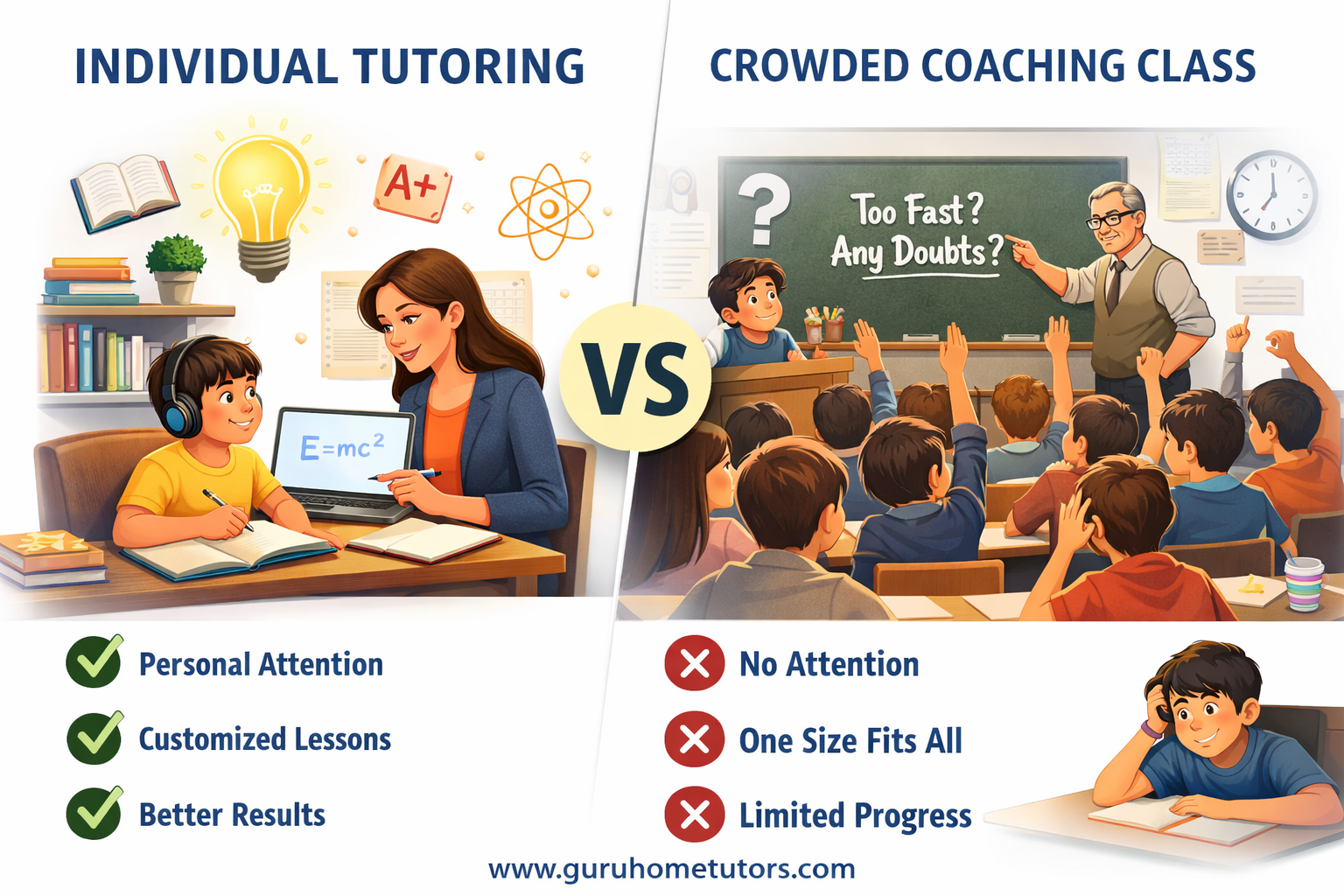
Online One-to-One Tuition vs Coaching: Which Is Better for Students?
Confused between coaching and online one-to-one tuition? The right choice depends on your child's academic level, learning style, examination goal, budget, schedule, and the amount of individual attention they need.
For some students, a good coaching institute provides the structure, competition and study material they need. For others, one-to-one online tuition can be more effective because the teacher can adapt the pace, teaching method, practice and doubt-solving to one student's requirements.
And for some serious JEE, NEET or board-exam students, the most practical solution can be coaching + one-to-one tuition for specific subjects or weak areas.
The important question is not “Which is universally better?” but “Which learning model is better for this particular student?”
This guide explains the difference between the two, online tuition fees, tutor selection, number of classes required, JEE/NEET preparation, demo classes and the factors parents should consider before spending money on tuition.
Quick Answer: Online One-to-One Tuition or Coaching?
Online one-to-one tuition is generally a better fit for students who need personalized attention, flexible scheduling, individual doubt solving or targeted help with weak subjects.
Coaching can be a better fit for students who learn comfortably in groups, follow a structured timetable and benefit from competition with peers.
| Your child's requirement | Usually more suitable |
|---|---|
| Individual attention | One-to-one tuition |
| Frequent doubts | One-to-one tuition |
| Flexible timing | One-to-one tuition |
| Weak fundamentals | One-to-one tuition |
| Fixed syllabus and timetable | Coaching |
| Competitive peer environment | Coaching |
| Large number of regular tests | Coaching |
| Personalized study plan | One-to-one tuition |
| School + competitive exam balance | One-to-one tuition / Hybrid |
| Needs both structure and individual support | Coaching + one-to-one tuition |
There is no single answer for every student. The right decision should be based on the student's actual academic requirements rather than simply choosing the option that is most popular.
What Is Online One-to-One Tuition?
Online one-to-one tuition is a personalized learning arrangement in which one tutor teaches one student through an online platform.
Unlike a large batch, the teacher does not have to follow exactly the same pace for dozens of students.
The tutor can spend more time on a difficult concept, move faster through topics the student already understands, provide additional questions when necessary and revisit previous concepts when an academic gap is identified.
For example, imagine a Class 10 student who is strong in algebra but struggling with geometry.
In a standard batch, the teacher may have to continue according to the planned schedule.
In a one-to-one class, the tutor can identify the specific difficulty, explain the concept differently, solve examples with the student, assign targeted practice and check whether the problem has actually been resolved.
That is the core difference: personalized teaching instead of one common pace for everyone.
Online One-to-One Tuition vs Coaching: The Real Difference
The biggest difference is not simply online versus offline.
It is:
Individualized learning vs group-based learning.
A coaching class normally works with a common academic plan.
One-to-one tuition can work with an individual academic plan.
Neither model is automatically good or bad. The better option depends on the student's learning requirements.
1. Teacher Attention
In a large coaching batch, the teacher's attention is divided among many students.
A one-to-one tutor has one student to focus on during the session.
This can be particularly valuable when the student:
-
Hesitates to ask questions
-
Has weak fundamentals
-
Needs repeated explanations
-
Requires additional practice
-
Learns at a different pace
-
Needs individual feedback
2. Learning Pace
A coaching batch generally moves according to its academic calendar.
In one-to-one tuition, the tutor can adjust the pace.
If the student understands a topic quickly, the class can move forward.
If the student is struggling, more time can be allocated to that topic.
3. Doubt Solving
One of the most important benefits of individual tuition is direct interaction.
The student does not need to wait for a dedicated doubt session or compete with other students for the teacher's attention.
A small doubt can be addressed immediately before it becomes a larger conceptual problem.
4. Study Plan
A coaching institute generally follows a standard plan for its batch.
A personal tutor can build the learning sequence around the student's:
-
Current academic level
-
School syllabus
-
Examination date
-
Weak chapters
-
Strengths
-
Previous performance
-
Target examination
This becomes especially relevant for students preparing for boards + JEE/NEET simultaneously.
Is One-to-One Tuition More Expensive Than Coaching?
It can be, but the answer depends on the tutor, class level, subject, number of classes and examination requirement.
Parents should not compare only the monthly tuition amount.
They should compare the total value received.
For example, a student may join a coaching programme for a relatively lower average cost per class but still require separate individual tuition for difficult subjects.
Another student may need only a few personalized classes every week to strengthen weak areas.
Therefore, the correct comparison is:
Total academic requirement + total cost + quality of teaching + amount of individual support
rather than simply:
“Which one has the lower fee?”
What Determines Online One-to-One Tuition Fees?
Online tuition fees can vary according to:
-
Class
-
Subject
-
Board
-
JEE/NEET or other competitive-exam level
-
Tutor qualification
-
Teaching experience
-
Subject specialization
-
Number of classes per week
-
Duration of each class
-
Student's current academic level
-
Preparation intensity
In Part 3 of this guide, we will break down online tuition fees in India with practical class-wise, subject-wise and competitive-exam-wise ranges.
For parents comparing tuition options in Lucknow, our detailed tuition fees in Lucknow guide can also be useful.
Who Should Choose Online One-to-One Tuition?
One-to-one tuition can be particularly useful when a student says:
“I understand some chapters, but I don't understand the others.”
or:
“I don't get enough time to ask my doubts.”
or:
“The class is moving too fast for me.”
or:
“I understand the theory but cannot solve questions.”
These are signs that the student may benefit from individualized academic support.
One-to-one tuition may be suitable for students who:
-
Need personalized attention
-
Have learning gaps
-
Need frequent doubt solving
-
Want flexible class timings
-
Are preparing for board examinations
-
Need support in Maths, Physics, Chemistry or Biology
-
Are preparing for JEE or NEET
-
Need additional help alongside coaching
-
Want a tutor to monitor their individual progress
Parents looking specifically for competitive-exam support can explore IIT JEE tutors or NEET tutors according to their requirement.
Who Should Choose Coaching?
Coaching can be a strong option for a student who:
-
Enjoys learning with other students
-
Is comfortable following a fixed schedule
-
Benefits from peer competition
-
Can independently identify and resolve many doubts
-
Wants a standardized study programme
-
Likes regular batch-level tests
-
Performs well in a competitive classroom environment
A disciplined and academically independent student can perform exceptionally well in a good coaching environment.
So this article is not about replacing every coaching class with private tuition.
It is about helping parents choose the learning environment that matches their child's needs.
What About Students Preparing for JEE or NEET?
Competitive examinations change the equation because students often need both:
Conceptual depth + consistent practice + examination strategy.
For JEE aspirants, individual tutoring can be particularly useful for:
-
Physics numericals
-
Chemistry concepts
-
Mathematics problem solving
-
Weak chapters
-
Advanced-level problems
-
Doubt solving
-
Test analysis
For NEET aspirants, it can support:
-
Physics problem solving
-
Chemistry concepts and MCQs
-
Biology revision
-
Weak-topic practice
-
Examination-oriented preparation
Students who already attend coaching do not necessarily have to leave it.
A hybrid model can work well:
Coaching → structured syllabus + tests + peer environment
One-to-one tuition → individual doubts + weak topics + personalized support
This can be a practical option when a student needs the strengths of both systems.
Online Tuition vs Home Tuition: Which Is Better?
Another question parents frequently face is whether to choose an online tutor or a tutor who visits home.
The answer again depends on the student.
| Factor | Online One-to-One | Home Tuition |
|---|---|---|
| Individual attention | Excellent | Excellent |
| Travel required | No | No for student |
| Tutor availability | Wider choice | Location dependent |
| Scheduling flexibility | Usually high | Depends on tutor |
| Face-to-face preference | Lower | Higher |
| Access to tutors outside your city | Yes | Usually limited |
| Suitable for | Students comfortable online | Students preferring physical classes |
If your child learns comfortably through digital classes, online tuition can provide access to tutors beyond the immediate locality.
If the child strongly prefers face-to-face interaction, home tuition may be the better choice.
Parents looking for face-to-face tutors in Lucknow can explore our home tutors in Lucknow network.
How Do You Know If Your Child Actually Needs a Personal Tutor?
Don't decide only because marks are low.
Look at the underlying problem.
Situation 1: Low marks because of weak concepts
Personalized tuition may help.
Situation 2: Good concepts but poor exam practice
The student may need a structured practice and test strategy.
Situation 3: Student understands everything but lacks discipline
A tutor alone may not solve the problem. A stronger routine and monitoring system may be required.
Situation 4: Student performs well in coaching but has difficulty in one subject
A subject-specific one-to-one tutor may be more sensible than replacing the entire coaching programme.
Situation 5: Student is preparing for JEE/NEET and has major gaps
Individual tutoring can be considered for targeted remediation while maintaining the broader preparation structure.
The goal should be to solve the academic problem—not simply to buy more classes.
What Should Parents Ask Before Hiring an Online Tutor?
Before paying for a long-term tuition package, ask:
About the tutor
-
What subjects do you specialize in?
-
How many years have you been teaching?
-
Which classes do you teach?
-
Do you teach CBSE, ICSE, ISC or UP Board?
-
Do you teach JEE Main/Advanced or NEET?
About the teaching
-
How do you identify weak areas?
-
How do you handle doubts?
-
Do you provide practice questions?
-
How frequently do you assess progress?
-
How do you prepare a student for examinations?
About the classes
-
How long is each class?
-
How many classes are recommended each week?
-
Is the schedule flexible?
-
What happens if a class needs to be rescheduled?
About the fee
-
What is the fee per class/hour?
-
Is there any package?
-
Are study materials included?
-
Is the demo class free?
-
What is the cancellation/refund policy?
A good tutor should be able to explain the teaching approach—not merely quote a price.
The Free Demo Class: Don't Waste It
A demo class should not be treated simply as a sample lecture.
It is an opportunity for the parent and student to evaluate the tutor.
During the demo, observe:
Does the tutor ask questions?
Does the tutor understand the student's level?
Does the tutor explain concepts clearly?
Does the student feel comfortable asking doubts?
Does the tutor identify mistakes instead of simply giving answers?
Is the teaching level appropriate for the student's examination goal?
A tutor who is excellent for a Class 8 student may not necessarily be the right choice for a JEE Advanced aspirant.
Tutor-student fit matters.
Need Help Finding the Right Tutor?
If you are still confused about whether your child needs online one-to-one tuition, home tuition, coaching or a combination, you don't have to make the decision based only on advertisements.
Tell us:
Class + Subject + Board + Current Level + Academic Goal + Preferred Schedule
and discuss the requirement before finalizing a tutor.
🎯 Book a Free Demo Class
Guru Home Tutors helps students find tutors for school subjects, board examinations and competitive examinations.
👉 Request a Student Registration / Tutor Requirement
📞 Call / WhatsApp: 8052230333
Start with a demo. Understand the teaching approach. Then decide.
Looking for a Tutor in a Specific City or Area?
Guru Home Tutors provides tutor-search resources across multiple locations.
For example:
For students looking for subject-specific help, you can also explore Maths tutors in Gomti Nagar and Physics tutors near you.
How Does Online One-to-One Tuition Actually Work? A Complete Guide for Parents and Students
Online one-to-one tuition sounds simple: one student, one teacher and a video call. But effective online tutoring is much more than a video meeting.
A well-structured online tuition class can include live teaching, digital whiteboard work, screen sharing, problem solving, doubt clarification, homework, tests, revision and regular feedback.
The biggest advantage is that the entire lesson can be adapted to one student's academic level and learning speed.
If you are considering online tuition for your child but are wondering whether it can really work as well as face-to-face tuition, this guide explains exactly how the process works.
Quick Answer: Online one-to-one tuition is a live personalized class where a tutor teaches one student remotely using video/audio communication and digital teaching tools. The tutor can explain concepts, solve questions, share screens or digital notes, assign practice and monitor the student's progress without requiring the student to travel to a coaching centre or tutor's home.
How Does an Online One-to-One Tuition Class Work?
A typical online tuition session follows a simple process.
Step 1: The Tutor Understands the Student
Before teaching starts, the tutor should understand:
-
Student's class
-
Board
-
Subject
-
Current academic level
-
Strong and weak chapters
-
School syllabus
-
Examination target
-
Previous test performance
-
Learning difficulties
-
Expected timeline
This first step is important because personalized tuition should begin with understanding the student, not simply opening the textbook at Chapter 1.
Step 2: The Tutor Creates a Learning Plan
After understanding the student's requirement, the tutor can decide:
-
What needs to be taught first
-
Which concepts need revision
-
Which chapters require additional practice
-
How much time should be given to theory
-
How much time should be given to questions
-
When tests should be conducted
-
When revision should happen
For example, a Class 12 student preparing for board examinations may need a different strategy from a Class 12 student preparing simultaneously for JEE Main and JEE Advanced.
Similarly, a student who has missed several foundational concepts may need a bridge or remedial plan before moving to advanced chapters.
What Happens During a Typical Online Tuition Class?
A productive one-hour session may look something like this:
5–10 minutes: Revision
The tutor checks what was covered previously.
Questions may include:
-
What did we learn last class?
-
Can you explain this formula?
-
Can you solve this basic question?
-
Where did you face difficulty in homework?
20–25 minutes: Concept Teaching
The tutor introduces or explains the topic using:
-
Digital whiteboard
-
Diagrams
-
Examples
-
Step-by-step derivations
-
Screen sharing
-
Questions and discussion
15–20 minutes: Guided Practice
The student solves questions while the tutor observes the approach.
This is extremely important.
A tutor should not spend the entire class solving questions for the student.
The student needs to solve questions with the tutor and eventually independently.
5–10 minutes: Doubts + Homework + Next Target
The tutor can finish by identifying:
-
Remaining doubts
-
Homework
-
Revision requirement
-
Next topic
-
Areas requiring additional practice
This creates a continuous learning cycle.
Can Online Tutors Teach Mathematics and Physics Effectively?
Yes, provided the teaching setup and methodology are appropriate.
Subjects such as Mathematics and Physics can actually benefit significantly from digital teaching tools.
For example, a tutor can use a digital whiteboard to:
-
Write equations
-
Draw graphs
-
Explain geometry
-
Derive formulas
-
Solve numerical problems
-
Annotate diagrams
-
Work through JEE-level problems step by step
The student can watch the solution being developed in real time rather than simply seeing a completed answer.
For students looking specifically for Maths support, you can explore Maths tutors in Gomti Nagar, Lucknow.
How Does Doubt Solving Work in Online One-to-One Tuition?
This is one of the biggest concerns parents have.
The answer is simple:
The student can ask the doubt during the live class.
The tutor can then:
-
Understand exactly where the student is stuck
-
Identify the conceptual problem
-
Explain the relevant principle
-
Solve a similar example
-
Ask the student to attempt the original problem
-
Check whether the student can now solve it independently
This is more useful than simply providing the final answer.
Example
Suppose a student cannot solve a Physics numerical.
Instead of saying:
“The answer is 20 N.”
the tutor should ask:
What information is given?
Which formula applies?
What are the units?
What concept is involved?
Where did your calculation go wrong?
That process develops problem-solving ability.
For students preparing specifically for Physics, our Physics tutors near you resource can help parents explore relevant tutoring options.
What About Homework in Online Tuition?
Online tuition should not mean:
Class ends → student logs off → nothing happens until the next class.
Homework and independent practice remain essential.
A tutor can assign:
-
Textbook questions
-
Worksheet problems
-
Previous-year questions
-
JEE/NEET MCQs
-
Board-style questions
-
Numerical problems
-
Revision exercises
-
Short concept tests
The amount of homework should depend on the student's class and objective.
A Class 7 student and a JEE Advanced aspirant obviously should not receive the same workload.
Can Online Tutors Conduct Tests?
Yes.
Tests can be incorporated into an online tuition programme in several ways.
Short Concept Tests
Useful after completing an individual topic.
Chapter Tests
Useful after completing a chapter.
Mixed Tests
Useful for checking whether the student can combine concepts.
Examination-Style Tests
Useful before school, board or competitive examinations.
But the test itself is only half the process.
Test analysis is equally important.
The tutor should identify:
-
Conceptual mistakes
-
Calculation mistakes
-
Questions left unanswered
-
Time-management issues
-
Repeated errors
-
Weak topics
A student who repeatedly makes the same mistake needs error analysis, not simply another test.
How Is Student Progress Monitored?
One-to-one tuition becomes significantly more valuable when progress is actually measured.
A tutor can monitor:
Concept understanding → Practice → Test performance → Mistake analysis → Revision → Retesting
For example:
| Area | Initial level | After targeted practice |
|---|---|---|
| Algebra | Weak | Improving |
| Quadratic equations | Average | Strong |
| Calculus | Weak | Needs more practice |
| Numerical accuracy | Low | Improving |
| Time management | Average | Improving |
The exact system may differ from tutor to tutor, but the principle remains the same:
Teaching should lead to measurable academic progress.
Parents should therefore ask tutors how they monitor progress before committing to long-term classes.
How Do Parents Know Whether the Tuition Is Working?
Don't judge the effectiveness of tuition only by asking:
“Did my child attend today's class?”
Attendance is not achievement.
Look for indicators such as:
-
Better conceptual understanding
-
Fewer repeated doubts
-
Improved homework quality
-
Higher accuracy
-
Better test scores
-
Improved question-solving speed
-
Greater confidence
-
More independent problem solving
-
Reduced dependence on the tutor
The last point is particularly important.
The ultimate goal of a good tutor should not be to make the student permanently dependent on the tutor.
The goal should be:
Teacher support → guided practice → independent problem solving.
What If the Student Is Not Comfortable With Online Classes?
This is a legitimate concern.
Not every student immediately adapts to digital learning.
Some students may:
-
Get distracted
-
Avoid participating
-
Feel uncomfortable speaking online
-
Have technical difficulties
-
Prefer physical interaction
That is why a demo class is valuable.
Instead of making a long-term decision based on assumptions, allow the student to experience the teaching method.
During the demo, observe:
Is the student interacting?
Is the tutor asking questions?
Can the student see the teaching material clearly?
Is the audio/video quality adequate?
Does the student understand the explanation?
Does the tutor adapt when the student struggles?
If the answer is yes, online tuition may be a suitable option.
Does Online Tuition Require Expensive Equipment?
Usually, no.
A student generally needs:
-
Smartphone, tablet or computer
-
Reliable internet connection
-
Headphones/earphones if required
-
Suitable study space
For subjects such as Mathematics and Physics, a larger screen can sometimes make equations, diagrams and digital whiteboard work easier to follow.
However, parents do not necessarily need to purchase expensive equipment before trying online tuition.
Start with a demo and determine what the student's actual learning setup requires.
What Makes a Good Online Tutor Different From an Average Online Tutor?
This is perhaps more important than the technology.
A tutor can have an excellent internet connection and still be a poor teacher.
A good online tutor should be able to:
Explain clearly
Not simply read from a textbook.
Ask questions
Teaching should be interactive.
Detect confusion
The tutor should notice when the student has not understood.
Adapt the explanation
Different students need different explanations.
Encourage independent thinking
The tutor should not solve every problem for the student.
Track progress
Weaknesses should be identified and revisited.
Prepare according to the student's goal
Board preparation and JEE Advanced preparation require different levels of depth.
Does Tutor Experience Matter?
Yes, but experience should not be the only selection criterion.
A tutor with 15 years of teaching experience may be excellent for one student, while another student may connect better with a younger tutor who has a strong command of a particular examination pattern.
Parents should consider:
-
Relevant teaching experience
-
Subject expertise
-
Examination experience
-
Communication
-
Teaching methodology
-
Student-tutor compatibility
-
Demo-class performance
-
Fee relative to the expected level of support
Don't ask only:
“How many years have you taught?”
Also ask:
“Have you taught students with requirements similar to mine?”
That is a much better question.
Can One Tutor Teach All Subjects?
Sometimes, but it is not always the best strategy.
For primary classes, a tutor may comfortably handle several subjects.
For higher classes, especially Class 11–12 and competitive examinations, subject specialization can become increasingly important.
For example:
JEE Mathematics → Mathematics specialist
JEE Physics → Physics specialist
JEE Chemistry → Chemistry specialist
Similarly, a NEET aspirant may benefit from subject-specific expertise.
For students who need multiple tutors, Guru Home Tutors can help parents explore subject-specific tutoring requirements rather than forcing one tutor to handle every advanced subject.
Online Tuition for JEE: What Should Be Different?
JEE preparation requires more than completing the NCERT or school syllabus.
Depending on the student's target, preparation may involve:
-
Conceptual depth
-
Advanced problem solving
-
Previous-year questions
-
Time-bound practice
-
Mixed-topic problems
-
Regular tests
-
Mistake analysis
-
Revision cycles
For JEE Main and JEE Advanced, the tutor should know the difference between:
“I can explain this chapter”
and
“I can train the student to solve examination-level problems from this chapter.”
Students looking for JEE support can explore IIT JEE tutors near you.
And if a student is preparing without conventional coaching, our guide on how to crack IIT JEE without coaching can provide additional context.
Online Tuition for Board Examinations: What Should Be Different?
Board preparation requires a different balance.
Students may need:
-
Complete syllabus coverage
-
NCERT/textbook understanding
-
Written-answer practice
-
Derivations
-
Diagrams
-
Previous-year questions
-
Sample papers
-
Revision
-
Time management
A tutor should therefore know the student's specific board and examination requirements.
The teaching strategy for CBSE, ICSE, ISC and UP Board may not always be identical.
How Many Online Tuition Classes Should a Student Take?
There is no universal number.
It depends on:
-
Class
-
Subject
-
Academic level
-
Examination target
-
Available time
-
Number of subjects
-
Current syllabus completion
-
Weak areas
A student who needs occasional academic support may need only a few classes per week.
A student preparing intensively for JEE or board examinations may require a more structured schedule.
More classes do not automatically mean better results.
The objective should be:
Enough teaching + enough practice + enough revision + enough independent study.
We will discuss the practical number of classes and weekly schedules in much greater detail in Part 5.
What Is the Biggest Advantage of Online One-to-One Tuition?
If we had to reduce the entire concept to one sentence:
The tutor can respond to the student rather than simply delivering the planned lesson.
If the student is confused → slow down.
If the student understands → move ahead.
If the student makes a repeated mistake → revisit the concept.
If the student is preparing for a difficult examination → increase the problem-solving level.
If the student has an academic gap → address it.
That adaptability is what makes one-to-one tuition different from a standard batch.
What Is the Biggest Disadvantage?
A trustworthy guide should also discuss the limitations.
Online one-to-one tuition may not be ideal if:
-
The student cannot maintain attention online
-
Internet connectivity is consistently poor
-
The student strongly prefers physical classes
-
The student lacks a suitable study environment
-
The tutor does not use an interactive teaching approach
And one-to-one tuition can cost more per teaching hour than some large-group coaching options.
That is why choosing the right tutor and the right number of classes matters.
How to Get the Maximum Benefit From Online Tuition
Parents and students can improve the effectiveness of online classes by following a few simple practices.
Before class
-
Keep books ready
-
Complete assigned homework
-
Note down doubts
-
Keep the study area distraction-free
-
Check internet and device
During class
-
Keep camera/audio working when appropriate
-
Ask doubts immediately
-
Solve questions yourself
-
Take short notes
-
Avoid multitasking
After class
-
Review the lesson
-
Complete homework
-
Mark difficult questions
-
Revise important formulas/concepts
-
Attempt assigned practice independently
This creates a complete cycle:
Learn → Practise → Test → Analyse → Revise → Improve
What Should You Expect From a Free Demo Class?
A free demo should help answer three questions:
1. Can the tutor teach?
Is the explanation clear?
2. Can the tutor understand the student?
Does the tutor identify the student's level and difficulties?
3. Can the student learn from this tutor?
Does the student feel comfortable asking questions and solving problems?
If all three answers are positive, you have a much stronger basis for making a decision.
Looking for an Online or Home Tutor?
If you already know the student's requirement, you can register your tutoring requirement with Guru Home Tutors.
You can provide the:
Class → Subject → Board → Location/Online Requirement → Academic Goal → Preferred Timing
Our team can then understand the requirement and help identify a suitable tutoring option.
🎯 Book a Free Demo
Call / WhatsApp: 8052230333
Don't choose a tutor only because the fee is low. Choose a tutor who can solve your child's actual academic problem.
Related Tutor Resources
If you are looking for a tutor in a particular area, you can explore relevant local tutor pages such as:
Online One-to-One Tuition Fees in India 2026: Class-Wise, Subject-Wise & JEE/NEET Fee Guide
How much does online one-to-one tuition cost in India?
This is one of the first questions parents ask before hiring a personal tutor.
The short answer is:
Online one-to-one tuition in India can cost anywhere from around ₹200 to ₹2,000+ per hour, depending on the student's class, subject, tutor experience, academic level and examination goal. School-level tutoring generally costs less, while specialized JEE, NEET and advanced-level tutoring can cost considerably more.
However, hourly price alone does not tell you whether a tutor is expensive or affordable.
A ₹500/hour tutor may be excellent value for a Class 8 student.
A ₹1,500/hour tutor may be reasonable for an experienced JEE Advanced specialist.
And a ₹700/hour tutor may be expensive if the teaching quality does not match the student's requirements.
So this guide doesn't simply tell you “how much tuition costs.”
It explains:
-
Online tuition fees by class
-
Subject-wise tuition rates
-
JEE and NEET tutor fees
-
Monthly tuition calculations
-
Experienced vs fresher tutor pricing
-
Online vs home tuition cost
-
Coaching vs one-to-one tuition cost
-
How many classes a student actually needs
-
How to compare two tutors charging different fees
-
Whether expensive tutors are always better
-
How to avoid overpaying
-
How to choose the right tutor within your budget
The objective is to help parents make a financially sensible and academically informed decision.
Quick Answer: How Much Does Online One-to-One Tuition Cost in India?
For general guidance, parents may encounter approximately these ranges in the Indian tutoring market:
| Student level | Indicative online 1-to-1 fee |
|---|---|
| Classes 1–5 | ₹250–₹600/hour |
| Classes 6–8 | ₹300–₹800/hour |
| Classes 9–10 | ₹400–₹1,000/hour |
| Classes 11–12 | ₹500–₹1,500/hour |
| Board-focused senior classes | ₹600–₹1,500/hour |
| JEE/NEET foundation | ₹600–₹1,200/hour |
| JEE Main / NEET | ₹800–₹1,500/hour |
| JEE Advanced / specialist preparation | ₹1,000–₹2,000+/hour |
These are indicative market ranges, not fixed national prices. Actual fees vary significantly depending on tutor profile, subject, experience, student level, class duration and preparation intensity. Current 2026 tutoring guides and platforms show similarly broad ranges, with school tutoring commonly below competitive-exam tutoring and specialist tutors reaching ₹2,000/hour or more.
Important:
Don't assume that a higher fee automatically means a better tutor.
Tutor quality and student-tutor fit matter more than price alone.
Why Do Online Tutors Charge Different Fees?
Two tutors teaching the same subject may charge completely different amounts.
For example:
Tutor A: ₹400/hour
Tutor B: ₹800/hour
Tutor C: ₹1,500/hour
Why?
Because tuition pricing can depend on several factors.
1. Tutor Experience
A tutor who has taught for many years may charge more than someone who is just starting.
But experience should be relevant.
For example, if your child is preparing for JEE Advanced, you should ask:
“Does this tutor have experience teaching JEE Advanced-level students?”
rather than simply:
“How many years have you taught?”
2. Academic Qualification
A tutor's academic background can influence fees, particularly for higher classes and competitive examinations.
However:
Qualification ≠ teaching ability.
A highly qualified tutor who cannot communicate concepts clearly may not be the right choice for your child.
Similarly, a tutor with a less impressive academic profile may be an excellent teacher.
3. Class Level
As academic difficulty increases, tuition fees generally increase.
Teaching Class 5 Mathematics is not the same as teaching:
Class 12 Calculus + JEE Advanced problem solving.
The preparation, expertise and depth required are different.
4. Subject
Some subjects and levels require more specialized expertise.
For example:
-
Primary-level English
-
Class 8 Mathematics
-
Class 10 Science
-
Class 12 Physics
-
JEE Mathematics
-
JEE Advanced Physics
should not necessarily have the same hourly rate.
5. Competitive Examination
Competitive examination tutoring often costs more than general school tuition because students may require:
-
Higher conceptual depth
-
Advanced problem solving
-
Previous-year questions
-
Exam strategy
-
Time-bound practice
-
Test analysis
-
Higher tutor specialization
Current Indian tutoring marketplaces and fee guides commonly show competitive-exam tutoring at a higher range than standard school tutoring.
Class-Wise Online Tuition Fees in India
Let's look at the pricing more practically.
Classes 1–5: Online Tuition Fees
Indicative range: ₹250–₹600 per hour
At this stage, tuition may focus on:
-
Basic Mathematics
-
English
-
Science
-
Reading
-
Writing
-
Homework support
-
Foundation development
Parents generally don't need to hire the most expensive tutor available.
For primary students, patience, communication and the ability to build strong fundamentals may be more important than an advanced academic profile.
Classes 6–8: Online Tuition Fees
Indicative range: ₹300–₹800 per hour
This is an important transition period.
Students begin encountering more demanding concepts in:
-
Mathematics
-
Science
-
English
-
Social Science
A good tutor should not simply help the student complete homework.
The focus should gradually shift toward:
Concept → Application → Practice → Independent problem solving
Classes 9–10: Online Tuition Fees
Indicative range: ₹400–₹1,000 per hour
Classes 9 and 10 are particularly important because students are building the academic foundation for senior secondary education and board examinations.
Tuition may include:
-
Mathematics
-
Science
-
English
-
Social Science
-
Board-oriented preparation
-
Previous-year questions
-
Revision
-
Test practice
Students with weak fundamentals may require more personalized support.
Classes 11–12: Online Tuition Fees
Indicative range: ₹500–₹1,500 per hour
At this level, subject specialization becomes increasingly important.
For example:
Class 12 Mathematics may involve advanced calculus, algebra and coordinate geometry.
Class 12 Physics may involve mechanics, electromagnetism, optics and modern physics.
Class 12 Chemistry may require physical, organic and inorganic chemistry preparation.
The appropriate fee therefore depends heavily on the tutor's subject expertise and the student's goal.
JEE Online Tuition Fees
JEE tutoring deserves separate consideration.
JEE Foundation
A reasonable broad range may be:
₹600–₹1,200/hour
JEE Main
A broad indicative range:
₹800–₹1,500/hour
JEE Advanced
For experienced specialists:
₹1,000–₹2,000+/hour
These are indicative rather than fixed rates.
There are tutors and services available below these ranges as well, while highly specialized tutors can charge significantly more.
For example, current online tutoring listings show JEE/NEET tutoring commonly extending into the ₹800–₹2,000/hour range depending on tutor experience and level.
What makes a JEE tutor more expensive?
Potential factors include:
-
Years of JEE teaching experience
-
IIT/NIT or other strong academic background
-
JEE Advanced specialization
-
Previous student results
-
Ability to teach difficult problems
-
Test-analysis methodology
-
Availability
-
Individual study planning
-
Subject specialization
But remember:
A high hourly rate is not proof of a high-quality JEE tutor.
Always evaluate the demo class and teaching methodology.
NEET Online Tuition Fees
For NEET preparation, parents may commonly encounter approximately:
NEET Foundation
₹600–₹1,200/hour
NEET-focused senior classes
₹800–₹1,500/hour
Highly experienced specialists
₹1,200–₹2,000+/hour
The actual rate depends on the subject and tutor.
For example, Physics and Chemistry may require a different tutoring profile from Biology.
A student may therefore choose:
One tutor for Physics + another for Chemistry + another for Biology
rather than paying one tutor to handle every subject.
Subject-Wise Online Tuition Fees
Approximate ranges can also be understood by subject.
| Subject / Level | Indicative range |
|---|---|
| English – school level | ₹250–₹700/hour |
| Mathematics – school level | ₹300–₹900/hour |
| Science – school level | ₹300–₹900/hour |
| Physics – Classes 11–12 | ₹500–₹1,500/hour |
| Chemistry – Classes 11–12 | ₹500–₹1,500/hour |
| Mathematics – Classes 11–12 | ₹500–₹1,500/hour |
| JEE Mathematics | ₹800–₹2,000+/hour |
| JEE Physics | ₹800–₹2,000+/hour |
| JEE Chemistry | ₹700–₹1,800+/hour |
| NEET Biology | ₹600–₹1,500/hour |
These figures should be treated as budgeting guidance rather than an official price list.
Actual tutor rates can be below or above these bands.
How Much Does Online Tuition Cost Per Month?
This is where parents often make a mistake.
They see:
₹800/hour
and assume the monthly cost is ₹800.
It isn't.
The monthly cost depends on number of classes × duration × hourly rate.
Example 1: ₹500/hour
2 classes per week:
₹500 × 2 × 4 = approximately ₹4,000/month
Example 2: ₹800/hour
3 classes per week:
₹800 × 3 × 4 = approximately ₹9,600/month
Example 3: ₹1,200/hour
3 classes per week:
₹1,200 × 3 × 4 = approximately ₹14,400/month
Example 4: ₹1,500/hour
4 classes per week:
₹1,500 × 4 × 4 = approximately ₹24,000/month
These are simple estimates using four weeks per month.
Some months contain more than four weeks, and tutors may use different package structures.
Monthly Fee Calculator: A Simple Formula
Parents can use:
Monthly tuition cost = Fee per class × Classes per week × 4
If the tutor charges by the hour:
Monthly tuition cost = Hourly rate × Class duration in hours × Classes per week × 4
For example:
₹1,000/hour × 1.5 hours × 3 classes/week × 4
= ₹18,000/month
This is why comparing tutors only on “₹ per class” can be misleading.
Always check:
How long is the class?
Is a ₹1,500/Hour Tutor Better Than a ₹500/Hour Tutor?
Not necessarily.
This is one of the most important things parents should understand.
Imagine two tutors:
Tutor A
₹500/hour
-
5 years teaching experience
-
Good communication
-
Strong school-level expertise
-
Excellent with Class 9–10 students
Tutor B
₹1,500/hour
-
15 years experience
-
Strong JEE Advanced expertise
-
Specialized in difficult Mathematics problems
For a Class 8 student:
Tutor A may be the better choice.
For a JEE Advanced aspirant:
Tutor B may justify the higher fee.
Therefore:
The right tutor is not necessarily the cheapest tutor or the most expensive tutor. It is the tutor whose expertise matches the student's actual requirement.
What Should You Get for a Higher Tuition Fee?
If a tutor charges significantly more, parents should reasonably expect stronger value.
That might include:
-
Greater subject expertise
-
More relevant experience
-
Personalized study planning
-
Regular assessment
-
Detailed doubt solving
-
Advanced problem selection
-
Test analysis
-
Progress tracking
-
Examination-specific preparation
But these should be verified, not assumed.
Don't pay ₹1,500/hour simply because someone calls themselves an “expert.”
Ask:
“What exactly will my child receive for this fee?”
Online Tuition vs Home Tuition: Which Costs More?
There is no universal rule.
Online tuition can sometimes be more economical because there is no travel involved.
Home tuition may cost more in some situations because the tutor has to travel to the student's location and spend additional time commuting.
However, the actual fee depends on:
-
City
-
Area
-
Tutor experience
-
Subject
-
Class
-
Travel distance
-
Number of classes
-
Student level
For parents comparing local tutoring options, Guru Home Tutors also provides area-specific resources such as home tutors in Gomti Nagar and home tutors in Aliganj.
Does Online Tuition Cost Less Than Coaching?
Sometimes yes.
Sometimes no.
The correct comparison requires looking at the total programme cost.
Suppose:
Coaching
Annual fee: ₹60,000
But the student still needs:
-
Additional private tuition
-
Extra doubt classes
-
Travel
-
Additional study support
The actual cost becomes higher than the advertised coaching fee.
Now consider:
One-to-One Tuition
₹800/hour × 3 classes/week × 40 weeks
= ₹96,000/year
It appears more expensive.
But if the student needs only one or two subjects, the calculation changes substantially.
For example:
₹800 × 2 classes/week × 40 weeks
= ₹64,000/year
Therefore, parents should compare:
Total annual cost + number of subjects + teaching hours + support included + student's actual requirement.
Can You Save Money by Taking Fewer One-to-One Classes?
Absolutely.
One-to-one tuition does not always have to mean:
“Tutor for every subject, every day.”
A more efficient strategy may be:
School + coaching + targeted tutoring
For example:
A student is comfortable in Chemistry but struggling badly with Mathematics.
Instead of hiring three private tutors, the family may choose:
One-to-one Mathematics tuition only.
This can dramatically reduce the total cost while addressing the actual academic problem.
How Many Classes Should You Pay For?
Don't buy a large package before understanding the student's needs.
As a rough planning guide:
| Requirement | Possible frequency |
|---|---|
| Homework / academic support | 1–2 classes/week |
| Concept strengthening | 2–3 classes/week |
| Board preparation | 2–4 classes/week |
| JEE/NEET subject support | 2–4 classes/week |
| Intensive weak-topic recovery | Depends on gap |
| Pre-exam revision | Temporary increased frequency |
These are planning examples, not fixed rules.
The tutor should recommend the frequency based on:
Current level + syllabus + target + timeline + available self-study time.
Should Parents Pay Per Class or Monthly?
Both models can work.
Pay Per Class
Useful when:
-
Starting with a new tutor
-
Student needs occasional support
-
Schedule changes frequently
-
Parents want flexibility
Advantage
Lower commitment.
Disadvantage
Long-term scheduling may be less predictable.
Monthly Package
Useful when:
-
Student needs regular classes
-
Tutor has fixed availability
-
Long-term preparation is planned
Advantage
Predictable schedule.
Disadvantage
Parents should understand the policy for:
-
Missed classes
-
Rescheduling
-
Holidays
-
Refunds
-
Tutor absence
Should You Take a Free Demo Before Paying?
Yes, whenever available.
A demo can help answer questions that a tutor profile cannot.
During the demo, check:
Does the tutor understand the student's level?
Is the explanation clear?
Does the tutor ask questions?
Can the student interact comfortably?
Is the teaching appropriate for the examination?
Does the tutor explain what should happen next?
A free demo should therefore be treated as a quality-check opportunity, not merely a promotional class.
If you want to discuss your child's requirement and explore a suitable tutor, you can register as a student with Guru Home Tutors.
What Is a Reasonable Tuition Budget for Different Students?
Instead of asking:
“What is the cheapest tutor?”
start with:
“What is a sensible budget for my child's requirement?”
Budget-conscious school student
Approximately:
₹300–₹700/hour
may provide many suitable options.
Board-focused Class 9–12 student
Approximately:
₹500–₹1,200/hour
can provide a wider range of subject-specialist options.
JEE/NEET student
Approximately:
₹700–₹1,500/hour
can be a reasonable starting budgeting range, with specialist tutors potentially charging more.
Advanced-level specialist
₹1,200–₹2,000+/hour
may be appropriate where the tutor has strong relevant expertise.
Again, these are planning ranges—not guarantees or mandatory market rates. Published 2026 Indian tutoring sources show similarly wide variation depending on level and tutor profile.
How to Avoid Overpaying for Online Tuition
Before hiring an expensive tutor, ask these seven questions:
1. Is the tutor experienced with my child's level?
2. Does the tutor specialize in the relevant subject?
3. Has the tutor taught this board/examination?
4. What exactly is included in the fee?
5. How frequently will progress be assessed?
6. Can the student take a demo?
7. Does the student actually learn well with this tutor?
If the answer to several of these questions is unclear, don't assume that a high fee means high quality.
How to Choose Between Two Tutors With Different Fees
Suppose you have two options:
Tutor A — ₹600/hour
Good school-level experience.
Tutor B — ₹1,000/hour
More experience and stronger competitive-exam expertise.
If your child is in Class 8:
Tutor A may provide better value.
If your child is in Class 12 preparing for JEE:
Tutor B may be worth the additional cost.
This leads to an important principle:
Match the tutor's expertise to the student's academic problem.
Don't pay for expertise your child doesn't need.
And don't choose a low-cost tutor if the student needs specialized expertise that the tutor cannot provide.
What Does Guru Home Tutors Charge?
Guru Home Tutors works with tutors whose fees can vary according to:
-
Class
-
Subject
-
Tutor experience
-
Student requirement
-
Competitive examination
-
Number of classes
-
Online/home mode
-
Academic level
Therefore, it is better to discuss the student's actual requirement rather than publishing one universal price for every tutor.
If you are looking for local tuition in Lucknow, you can also refer to the tuition fees in Lucknow guide.
For students in Mumbai, see the tuition fees in Mumbai guide.
The Cheapest Tutor Is Not Always the Most Affordable Tutor
This sounds contradictory, but it matters.
Suppose a ₹400/hour tutor needs six months to help a student understand a topic that a more suitable ₹800/hour tutor could address much faster.
The lower hourly rate may not necessarily mean lower overall educational cost.
Likewise, hiring an expensive tutor for a student who does not need that level of specialization can also be wasteful.
The real calculation is:
Tutor fee × number of classes required × quality of learning
not simply:
Tutor fee per hour
A Simple Formula for Choosing a Tutor
Parents can think about tutor value using:
Value = Teaching Quality + Relevant Expertise + Personalization + Progress Monitoring ÷ Total Cost
It is not a mathematical formula in the strict sense.
It is a decision-making framework.
A tutor becomes more valuable when the teaching is:
Relevant + Personalized + Measurable + Effective
Before You Hire: Use This 5-Point Checklist
Ask yourself:
✓ Does the tutor understand my child's level?
✓ Does the tutor have relevant subject/exam experience?
✓ Is the fee appropriate for the required expertise?
✓ Does the tutor provide a clear learning plan?
✓ Did the student respond positively to the demo?
If the answer is yes to all five, you have a much stronger basis for proceeding.
Ready to Find a Tutor Within Your Budget?
You don't have to decide the tutor only by looking at an hourly rate.
Tell us:
Class + Subject + Board + Academic Goal + Online/Home Requirement + Preferred Schedule
and discuss the requirement before finalizing the tutor.
🎯 Request a Free Demo
Guru Home Tutors
Online & Home Tutors for:
School | Boards | JEE | NEET | Competitive Exams
📞 Call / WhatsApp: 8052230333
👉 Register Your Student Requirement
Find the right tutor for the student's requirement—not simply the lowest-priced tutor.
Frequently Asked Questions About Online Tuition Fees
How much does one-to-one online tuition cost in India?
Online one-to-one tuition can broadly range from around ₹200 to ₹2,000+ per hour, depending on class, subject, tutor experience and examination level. School-level tutoring is generally less expensive than specialized JEE/NEET or advanced-level tutoring.
What is the average online tuition fee for Class 10?
A broad budgeting range is approximately ₹400–₹1,000 per hour, although actual rates vary according to subject, board and tutor experience.
How much does a Class 12 online tutor charge?
Class 12 tutoring can broadly range from ₹500 to ₹1,500 per hour, with specialized competitive-exam tutors potentially charging more.
How much does a JEE online tutor charge?
JEE tutoring commonly falls around ₹800–₹1,500 per hour for many tutoring arrangements, while highly experienced JEE Advanced specialists may charge ₹2,000 or more per hour.
Is ₹1,000 per hour expensive for an online tutor?
Not necessarily. ₹1,000/hour can be reasonable if the tutor's expertise matches the student's level and the teaching provides strong personalized value.
Is a more expensive tutor always better?
No. A higher fee does not automatically mean better teaching. Parents should evaluate subject expertise, relevant experience, teaching quality, demo performance and student-tutor compatibility.
Is online tuition cheaper than home tuition?
It can be, but there is no universal rule. Online tuition removes travel requirements and can provide access to tutors outside the student's locality, while home tuition may involve additional travel time and location-related costs.
How many online tuition classes should a student take?
It depends on the student's class, academic level, subject, examination target and available study time. Many students may need 1–4 classes per week for a subject, but intensive preparation can require a different schedule.
Should I pay monthly or per class?
Both options can work. Per-class payment provides flexibility, while monthly arrangements may be useful for students who need a regular long-term schedule. Always clarify cancellation and rescheduling terms before paying.
Next Part: How Many Classes Does Your Child Actually Need?
Knowing the hourly fee is only half the calculation.
The next question is:
“Agar tutor ₹800 ya ₹1,000 per hour charge karta hai, to week mein kitni classes leni chahiye?”
Should a Class 8 student take two classes or three?
Does a Class 10 board student need daily tuition?
How many hours should a JEE aspirant study with a private tutor?
Should Maths, Physics and Chemistry each have separate tutors?
And can taking too many tuition classes actually reduce the student's self-study time?
Part 5 will answer these questions with practical weekly schedules, class-frequency examples and subject-wise planning.
Online One-to-One Tuition vs Coaching vs Home Tuition: Which Is Actually Better?
Choosing between coaching, home tuition and online one-to-one tuition is not simply a question of which option is cheaper. The right choice depends on your child's academic level, learning style, examination target, need for personal attention and total education budget.
Many parents make this decision in a hurry.
One neighbour says:
“Coaching join kara do, sab bachche wahi kar rahe hain.”
Another says:
“Personal tutor hi best hai.”
Someone else says:
“Online classes sasti bhi hain aur convenient bhi.”
But there is no single answer that works for every student.
A Class 5 student, a Class 10 board student and a JEE Advanced aspirant can have completely different tutoring requirements.
This guide compares all three major options:
Online one-to-one tuition vs home tuition vs coaching
and explains when each one makes sense.
Quick Answer: Which Is Better—Coaching, Home Tuition or Online One-to-One Tuition?
For personalized learning: One-to-one tuition usually has the advantage.
For peer environment and large-scale structured preparation: Coaching can be useful.
For students who need face-to-face interaction at home: Home tuition can be a strong option.
For students who need flexibility, subject specialists and no travel: Online one-to-one tuition can be particularly convenient.
The best choice depends on the student's actual requirement.
A student who is already performing well in a coaching batch may not need private tuition.
A student who is struggling to understand concepts in a 50-student classroom may benefit enormously from one-to-one support.
Online One-to-One Tuition vs Coaching vs Home Tuition
Here is the simplest comparison:
| Factor | Online 1-to-1 Tuition | Home Tuition | Coaching |
|---|---|---|---|
| Personal attention | ⭐⭐⭐⭐⭐ | ⭐⭐⭐⭐⭐ | ⭐⭐ |
| Flexible timing | ⭐⭐⭐⭐⭐ | ⭐⭐⭐ | ⭐⭐ |
| Travel required | No | Tutor travels | Usually yes |
| Personalized pace | Excellent | Excellent | Limited |
| Peer competition | Low | Low | High |
| Doubt solving | Direct | Direct | Depends on batch |
| Subject specialist access | High | Depends on locality | Usually available |
| Suitable for weak students | Excellent | Excellent | Depends on batch |
| Suitable for independent students | Excellent | Excellent | Excellent |
| Cost per student | Can vary | Can vary | Usually lower per student |
| Study environment | Home | Home | Coaching centre |
| Customized study plan | High | High | Usually standardized |
The important point is that coaching and one-to-one tuition solve different problems.
So comparing them only by price is incomplete.
What Does Coaching Actually Offer?
A coaching institute generally provides a structured learning environment.
Students may receive:
- Fixed timetable
- Group teaching
- Study material
- Regular tests
- Peer competition
- Doubt sessions
- Performance rankings
- Examination-oriented preparation
For highly disciplined students who can keep up with the batch, this structure can be useful.
The major limitation is obvious:
The teacher has to teach the batch, not just your child.
If 60 students are sitting in a classroom, the teacher cannot realistically spend equal individual time diagnosing every student's weakness during the main lecture.
Some coaching environments are much better organized than others, of course.
So the question isn't:
“Is coaching bad?”
The better question is:
“Does my child learn effectively in a group environment?”
What Does One-to-One Tuition Offer?
One-to-one tuition changes the fundamental teaching model.
Instead of:
Teacher → 40–100 students
you have:
Teacher → One student
That means the tutor can adjust:
- Teaching speed
- Difficulty level
- Number of examples
- Revision time
- Homework
- Doubt-solving time
- Test frequency
- Chapter sequence
If a student understands a topic quickly, the tutor can move forward.
If the student struggles, the tutor can stop.
This is the central advantage of personalized tutoring.
Current 2026 comparisons of online tutoring and coaching similarly identify personalized attention and customized pacing as major differences between one-to-one tutoring and group learning.
What Does Home Tuition Offer?
Home tuition provides one-to-one interaction without requiring the student to travel to a coaching centre.
For some students, this is the ideal combination:
Personal teacher + physical interaction + familiar home environment
It can be particularly useful for:
- Younger students
- Students requiring close supervision
- Students who struggle with online learning
- Students needing regular homework support
- Parents who prefer face-to-face teaching
The disadvantage is that the choice of tutors can become more dependent on the availability of suitable teachers in the student's locality.
Online tuition removes much of that geographical limitation.
The Real Cost of Coaching Is More Than the Advertised Fee
This is something parents should calculate carefully.
Suppose a coaching programme costs:
₹1,00,000 per year
It is tempting to think:
“That's my total education expense.”
But there can be additional costs.
For example:
- Transportation
- Study material
- Test series
- Additional doubt classes
- Extra tuition
- Books
- Food/snacks during long sessions
- Accommodation in another city
- Travel home
- Time spent commuting
Not every coaching student will incur all of these expenses.
But they should be considered when comparing options.
For JEE preparation in particular, published and community-reported costs can vary enormously depending on whether the student attends local coaching, a major coaching centre, or residential coaching.
Don't Compare ₹1,000 Per Hour With ₹1 Lakh Per Year
This is a very common mistake.
The units are different.
Suppose online tuition costs:
₹1,000/hour
and the student takes:
3 classes per week
for:
40 weeks
Then:
₹1,000 × 3 × 40
= ₹1,20,000 per year
Now suppose coaching costs:
₹1,00,000 per year
At first glance, coaching looks cheaper.
But ask:
How many classroom hours are included?
How many subjects?
Are tests included?
Is study material included?
Does the student require additional tuition?
How much travel is involved?
Does the student actually need all the coaching hours?
That is the real comparison.
A Better Way to Calculate Tuition Value
Instead of comparing only the annual fee, calculate:
Total Cost of Learning
This can include:
Tuition/coaching fee
Travel
Books/material
Test series
Additional tuition
Accommodation, if applicable
Time cost
Now the comparison becomes much more meaningful.
Example: Three Different Students
Let's imagine three students.
Student A — Class 8
The student understands most concepts but struggles with Mathematics.
Coaching:
₹4,000/month
Private Mathematics tutor:
₹600/hour × 2 classes/week
≈ ₹4,800/month
Does the student really need a complete coaching programme?
Probably not.
A targeted one-to-one Mathematics tutor may solve the actual problem more efficiently.
Student B — Class 10 Board Student
The student has:
- Mathematics weakness
- Science doubts
- Upcoming board examination
The student may benefit from:
2–3 focused private classes per week
rather than joining a large coaching programme for every subject.
A hybrid strategy can work:
School + self-study + targeted one-to-one tuition
This can be much more efficient for some students.
Student C — Class 11 JEE Aspirant
Now the situation changes.
The student may require:
- Physics
- Chemistry
- Mathematics
- Regular tests
- Large question bank
- Competition
- Examination strategy
- Consistent study schedule
Here, a strong coaching programme can provide structure.
But even then, one-to-one tuition can be useful if the student has a specific weakness.
For example:
Coaching + one-to-one Mathematics tutor
may be more sensible than abandoning the entire coaching programme.
The Hybrid Model May Actually Be the Smartest Option
Parents sometimes think they must choose:
Coaching OR private tuition
But they don't necessarily have to.
A student can use:
Coaching for structured syllabus coverage
One-to-one tuition for weak subjects
Self-study for revision
This can be particularly useful when the student is comfortable with two subjects but struggling with one.
For example:
JEE coaching
- one-to-one Physics tuition
may be better than taking private tuition for all three subjects.
The same principle applies to board examinations.
When Should You Choose Coaching?
Coaching may be a good fit when your child:
✓ Enjoys competition
Some students become more motivated when they see peers solving difficult questions.
✓ Needs external discipline
A fixed schedule can help students who struggle to study independently.
✓ Wants a structured examination programme
Large coaching institutes often provide:
- Planned syllabus
- Test schedules
- Study material
- Revision plans
✓ Is already academically strong
Students who can keep pace with a batch may benefit from the group environment.
✓ Wants exposure to a large peer group
For some competitive-exam students, this can be valuable.
When Should You Choose One-to-One Online Tuition?
Online one-to-one tuition may be a better fit when your child:
✓ Has specific weak subjects
Instead of paying for an entire coaching programme, target the problem.
✓ Is afraid to ask doubts in class
One-to-one tutoring removes the embarrassment of asking “basic” questions.
✓ Learns slower or faster than the batch
The tutor can adjust the pace.
✓ Has an irregular school schedule
Online classes can often be scheduled more flexibly.
✓ Needs a subject specialist
You can choose a tutor specifically for:
Mathematics, Physics, Chemistry, Biology, English, etc.
✓ Lives in an area with limited tutor availability
Online learning can connect the student with tutors outside the immediate locality.
✓ Wants to save travel time
There is no daily journey to a coaching centre.
When Is Home Tuition Better Than Online Tuition?
Home tuition can be preferable when:
- The student is very young
- The student struggles with screen-based learning
- Parents want physical supervision
- Face-to-face interaction works better
- The student needs frequent physical notebook checking
- Internet connectivity is unreliable
For students who learn well online, however, the absence of travel can be a significant advantage.
What About a Student Who Gets Distracted Online?
This is a legitimate concern.
Not every student is naturally suited to online learning.
Parents should watch for:
- Mobile distractions
- Gaming
- Social media
- Multitasking
- Poor attention
- Avoiding participation
But don't blame the medium automatically.
A badly conducted online class can be boring.
A highly interactive one-to-one class can be extremely engaging.
The quality of teacher + student interaction + environment matters.
Which Option Is Better for Weak Students?
This is where one-to-one tuition can have a particularly strong advantage.
Imagine a student who has not understood:
Fractions → Algebra → Linear equations
and is now struggling with:
Quadratic equations
A batch teacher has to continue according to the syllabus.
A private tutor can say:
“Before we start quadratic equations, let's repair the algebra foundation.”
Then the tutor can spend two or three classes fixing the missing concepts.
This is called learning-gap remediation.
And it is one of the strongest reasons parents choose personal tutoring.
Which Option Is Better for Toppers?
Interestingly, toppers may also benefit from one-to-one tuition.
But the objective changes.
A weak student may need:
Foundation → Clarity → Practice
A strong student may need:
Advanced concepts → Difficult problems → Time optimization → Error elimination
A JEE Advanced aspirant, for example, may not need someone to teach basic theory repeatedly.
The student may need a tutor who can challenge them with difficult problems.
So:
Weak student → remedial personalization
Strong student → advanced personalization
Both are forms of personalized learning.
Does Coaching Guarantee Better Results?
No.
And neither does private tuition.
A student's result depends on multiple factors:
- Quality of teaching
- Student effort
- Attendance
- Self-study
- Practice
- Revision
- Test performance
- Time management
- Academic foundation
- Consistency
Joining a famous coaching institute does not automatically produce a good rank.
Similarly, hiring an expensive private tutor does not automatically produce high marks.
The real question is:
Does the learning system actually improve the student's understanding and performance?
Does One-to-One Tuition Guarantee Better Results?
No.
This distinction is important for an honest education guide.
One-to-one tutoring provides more personalization, but personalization itself does not guarantee results.
The tutor still needs:
- Strong subject knowledge
- Good pedagogy
- Proper planning
- Student cooperation
- Regular practice
- Progress monitoring
The student's effort remains critical.
What About Group Coaching Fees?
Group coaching can be economically attractive because the cost of one teacher is distributed across many students.
That is why group learning can sometimes provide considerably more teaching hours for the same individual budget.
Current 2026 comparisons also show group classes generally costing less per student than private tutoring, while private tutoring offers more individualized support.
Therefore:
If budget is the biggest constraint:
Group coaching may win.
If personalization is the biggest requirement:
One-to-one tuition may win.
What Is the Best Option for Board Students?
For many board students, the answer is:
School + self-study + targeted tuition
rather than automatically joining a large coaching programme.
For example:
A Class 12 student may be excellent in English and Economics but weak in Physics and Mathematics.
Why pay for an entire multi-subject coaching package?
A more targeted approach could be:
School
Maths tutor
Physics tutor
Self-study
This can provide much more focused support.
What Is the Best Option for JEE Students?
There is no universal answer.
Option 1: Full Coaching
Best suited to students who need:
- Structure
- Competition
- Study material
- Tests
- Fixed routine
Option 2: One-to-One Tuition
Can suit students who need:
- Individualized preparation
- Flexible schedule
- Subject specialization
- Personalized problem solving
Option 3: Hybrid
Often worth considering:
Coaching + private tutor for difficult subjects
or
School + one-to-one tutors + test series + self-study
The right option depends on the student.
For students specifically looking for JEE tutors, Guru Home Tutors also has a dedicated IIT JEE tutor search page.
A Simple Decision Matrix for Parents
Use this:
| Your child's situation | Consider |
|---|---|
| Needs basic academic support | One-to-one tuition |
| Has one weak subject | Targeted private tuition |
| Needs strict routine | Coaching |
| Loves competition | Coaching |
| Shy about asking doubts | One-to-one |
| Learns at a different pace | One-to-one |
| Needs face-to-face supervision | Home tuition |
| Has limited local tutor options | Online tuition |
| Strong JEE aspirant | Coaching / specialist 1-to-1 / hybrid |
| Very weak foundation | One-to-one or hybrid |
| Comfortable with most subjects | Targeted tuition |
| Needs multiple subjects + tests + structure | Coaching |
| Needs advanced problem solving | Specialist one-to-one |
The Most Important Question: What Problem Are You Trying to Solve?
Before spending money, ask:
Is my child struggling because of lack of teaching?
Or lack of practice?
Or lack of discipline?
Or weak fundamentals?
Or poor time management?
Or examination anxiety?
Or simply too many distractions?
This matters because different problems require different solutions.
For example:
Weak concepts → tutor
No discipline → structured coaching/study system
One difficult subject → targeted one-to-one
Lack of practice → worksheets/tests
Poor time management → timed practice
Multiple academic gaps → personalized study plan
Don't buy an education product before identifying the problem.
A ₹10,000 Coaching Fee May Be Expensive for One Student and Cheap for Another
This sounds strange, but consider two students.
Student A
Already performs well independently.
Needs only occasional doubt solving.
₹10,000/month coaching may be unnecessary.
Student B
Cannot maintain a study schedule independently.
Needs:
- Daily structure
- Tests
- Competition
- Teacher supervision
- Study material
For this student, ₹10,000/month may actually be reasonable.
Therefore:
Affordability is relative to the student's requirement—not simply the advertised fee.
Online Tuition Can Also Reduce the Hidden Cost of Time
This is an overlooked factor.
Suppose a student spends:
45 minutes travelling to coaching
and
45 minutes returning
That's:
90 minutes per day.
For three days a week:
4.5 hours/week
Over 40 weeks:
180 hours/year
Those hours could potentially be used for:
- Revision
- Homework
- Sleep
- Exercise
- Practice tests
- Self-study
This doesn't mean travel is always wasted.
But parents should include it in the decision.
How to Decide in 10 Minutes
Ask your child these questions:
1. Do you understand most topics taught in school?
2. Do you hesitate to ask doubts in a group?
3. Do you need someone to explain concepts repeatedly?
4. Can you study independently every day?
5. Do you enjoy competition?
6. Are you preparing for boards, JEE, NEET or another competitive exam?
7. Which subjects are actually weak?
8. Do you need a complete programme or only targeted help?
The answers will usually make the decision much clearer.
What If You Are Still Confused?
Don't commit to a full-year programme immediately.
Try the teaching method first.
A demo class can reveal:
- Whether the student understands the teacher
- Whether the tutor can identify weaknesses
- Whether online teaching works for the student
- Whether the teaching pace is appropriate
- Whether the student feels comfortable asking questions
This is why Guru Home Tutors encourages parents to discuss their actual requirement before finalizing a tutor.
Looking for a Tutor Instead of a Large Coaching Batch?
If your child needs personalized academic support, you can register the student's requirement with Guru Home Tutors.
You can mention:
Class + Board + Subject + Current Level + Exam Target + Preferred Timing + Online/Home Requirement
📞 Call / WhatsApp: 8052230333
Our goal should not be to put every student into the same type of tuition.
The right tutor is the one who solves the student's actual academic problem.
Frequently Asked Questions
Is online one-to-one tuition better than coaching?
It can be better for students who need personalized attention, flexible scheduling, targeted doubt solving or customized pacing. Coaching can be better for students who benefit from structured schedules, peer competition, study material and regular group tests.
Is home tuition better than online tuition?
Neither is universally better. Home tuition provides face-to-face interaction, while online tuition provides greater flexibility and access to tutors beyond the student's locality.
Is coaching cheaper than private tuition?
Usually, group coaching has a lower per-student cost because the teacher's time is shared among many students. However, parents should compare the total annual cost, additional tuition, travel and included services rather than comparing only the headline fee.
Can a student prepare for JEE without coaching?
Yes, it is possible, but the student needs a disciplined preparation system, appropriate study material, regular practice and testing. Some students use self-study plus specialized one-to-one tutoring instead of conventional coaching.
Should I choose coaching or one-to-one tuition for JEE?
It depends on the student. Coaching can provide structure, peer competition and regular testing. One-to-one tuition can provide personalized teaching and targeted support. A hybrid model can also be effective.
Is one-to-one tuition worth the extra money?
It can be, particularly when the student has specific learning gaps or needs personalized attention. But parents should evaluate the tutor's actual effectiveness rather than assuming that one-to-one automatically means better results.
What if my child is already enrolled in coaching but still struggles?
You do not necessarily need to leave coaching. Consider identifying the specific weak subject or concept and adding targeted one-to-one tuition.
Final Verdict: Don't Choose the Institution. Choose the Learning Model.
There is no universal winner.
Choose coaching when your child needs:
Structure + Competition + Tests + Peer Environment
Choose home tuition when your child needs:
Personal Attention + Face-to-Face Interaction + Home Convenience
Choose online one-to-one tuition when your child needs:
Personalization + Flexibility + Specialist Teacher + No Travel
And choose hybrid learning when your child needs a combination of these.
The smartest education decision isn't:
“Which option is famous?”
It is:
“Which option solves my child's current academic problem most efficiently?”
🎯 Not Sure Which Tutor or Learning Model Is Right?
Tell us your child's:
Class | Subject | Board | Current Academic Level | Examination Target | Preferred Timing
and discuss the requirement before making a long-term commitment.
Book a Free Demo Class
📞 Call / WhatsApp: 8052230333
👉 Register Student Requirement
Explore More Tutor Resources
- Tuition Fees in Lucknow
- Tuition Fees in Mumbai
- IIT JEE Tutors Near Me
- Top Physics Tutors Near Me
- Home Tuition FAQ
- Home Tutors in Gomti Nagar
- Home Tutors in Lucknow
Coming Next: How Many Tuition Classes Does Your Child Actually Need?
You've now answered:
What is online tuition?
How much does it cost?
Online tuition vs coaching vs home tuition—what is the difference?
But there is one extremely important question left:
“Mere child ko actually week mein kitni classes chahiye?”
Because taking too few classes may not solve the academic problem.
But taking too many classes can eat into the most important part of education:
How Many Tuition Classes Does a Student Actually Need? Class-Wise & Exam-Wise Guide
How many online tuition classes should a student take every week?
This is one of the most important questions parents should ask before hiring a tutor.
A common assumption is:
“Agar 5 din tuition hogi to result better hoga.”
Not necessarily.
A student can attend tuition for several hours every week and still perform poorly if there is not enough time for:
- Self-study
- Homework
- Question practice
- Revision
- Tests
- Mistake analysis
- Rest and sleep
On the other hand, a student with serious learning gaps may genuinely need more frequent one-to-one support.
So the right question is not:
“How many tuition classes can we afford?”
It is:
“How many guided teaching hours does this student actually need to make measurable progress?”
This guide explains how to decide.
Quick Answer: How Many Tuition Classes Per Week Are Usually Enough?
As a broad planning guide:
| Student requirement | Suggested starting frequency |
|---|---|
| Light academic support | 1–2 classes/week |
| Concept strengthening | 2–3 classes/week |
| One weak subject | 2–3 classes/week |
| Board preparation | 2–4 classes/week per subject |
| Class 11–12 difficult subject | 2–4 classes/week |
| JEE/NEET subject support | 2–4 classes/week per subject |
| Major learning gaps | 3–5 classes/week temporarily |
| Intensive pre-exam preparation | Depends on syllabus gap |
These are starting points, not fixed rules.
The ideal frequency depends on:
Class + subject + current level + examination target + syllabus remaining + self-study ability.
The Most Important Rule: Tuition Should Not Replace Self-Study
This is where many parents accidentally go wrong.
Suppose a student takes:
2 hours of tuition every day
That sounds impressive.
But if the student spends almost all available study time sitting in tuition, there may be very little time left to actually solve problems independently.
And independent problem solving is particularly important for:
- Mathematics
- Physics
- Chemistry
- JEE
- NEET
- Board examinations
A useful learning cycle is:
Learn → Practise → Test → Analyse → Revise
Tuition primarily supports the Learn + Guided Practice stages.
The student still needs sufficient time for the remaining stages.
How Long Should One Online Tuition Class Be?
There is no universal ideal duration.
But these are practical ranges:
Classes 1–5
30–60 minutes
Classes 6–8
45–60 minutes
Classes 9–10
60–90 minutes
Classes 11–12
60–120 minutes
JEE/NEET advanced preparation
60–120 minutes, depending on subject and lesson complexity.
A two-hour class is not automatically better than a one-hour class.
If the student loses concentration after 60 minutes, extending the class may actually reduce effectiveness.
Classes 6–8: How Much Tuition Is Enough?
For many students in Classes 6–8, tuition should primarily strengthen fundamentals.
Student with Good Academic Performance
If the student understands school lessons well:
1–2 classes per week
may be enough for a particular subject.
The remaining time can be used for:
- Homework
- Reading
- Practice
- Revision
- Independent learning
Student With Moderate Difficulty
If Mathematics or Science is becoming difficult:
2–3 classes per week
may be a reasonable starting point.
The tutor can focus on:
- Concept clarity
- School syllabus
- Homework
- Additional questions
- Foundation building
Student With Significant Learning Gaps
If the student has major foundational gaps:
3–4 classes per week
may temporarily be appropriate.
But once the gap is repaired, frequency should ideally be reassessed.
Don't create permanent dependence on tuition.
The goal is to gradually make the student more independent.
Example Weekly Schedule: Class 7 Mathematics
Suppose the student needs Mathematics support.
A practical schedule might look like:
Monday: 1-hour tuition
Tuesday: 30–45 minutes independent practice
Wednesday: 1-hour tuition
Thursday: Homework + revision
Friday: Independent problem solving
Saturday: Short revision/test
Sunday: Rest or backlog completion
This provides teaching and enough independent work.
Classes 9–10: How Many Classes Are Needed?
Classes 9 and 10 require more structured preparation.
Students may be preparing for:
- School examinations
- Board examinations
- Competitive foundation
- Olympiads
- Future JEE/NEET preparation
So tuition frequency depends heavily on the objective.
Class 9–10: One Weak Subject
Suppose the student is good in English and Social Science but struggling in Mathematics.
Instead of taking tuition for every subject:
Mathematics: 2–3 classes/week
may be sufficient.
This targeted approach can be considerably more efficient than paying for unnecessary instruction.
Class 10 Board Preparation
For a student who needs regular board support:
2–4 classes per week per difficult subject
can be considered.
For example:
Mathematics: 3 classes/week
Science: 2 classes/week
while the student handles other subjects independently.
The exact combination depends on the student's school performance.
Should Class 10 Students Take Daily Tuition?
Not necessarily.
Daily tuition can make sense during a short intensive period if:
- Exams are close
- Syllabus is incomplete
- Student has major gaps
- Revision is behind schedule
But taking daily tuition throughout the entire year may leave insufficient time for independent practice.
Tuition should support preparation—not consume the entire preparation.
Classes 11–12: The Situation Changes
Classes 11 and 12 are academically much more demanding.
Students may be preparing simultaneously for:
- School examinations
- Board examinations
- JEE
- NEET
- CUET
- Other competitive examinations
At this stage, subject specialization becomes increasingly useful.
Class 11–12: One Difficult Subject
Suppose a student struggles with Physics.
A practical starting point may be:
2–3 classes/week
Each class:
60–120 minutes
The student then needs additional time for:
- Numerical practice
- Formula revision
- Previous-year questions
- Homework
- Error analysis
Class 11–12: All Three PCM Subjects
For a student taking Mathematics, Physics and Chemistry:
It is not always necessary to have:
3 subjects × 5 classes/week
That can become excessive.
A more balanced approach could be:
Mathematics: 2–3 classes/week
Physics: 2–3 classes/week
Chemistry: 2–3 classes/week
The total depends on whether the student is also attending coaching or school support.
JEE Preparation: How Many Tuition Classes Are Needed?
JEE preparation requires a different approach.
The student needs substantial independent problem solving.
So tuition should not become the entire preparation.
For one JEE subject:
2–4 classes/week
can be a practical starting range.
For example:
JEE Mathematics: 3 × 90 minutes
JEE Physics: 3 × 90 minutes
JEE Chemistry: 2 × 90 minutes
That already creates a substantial weekly teaching load.
The student still needs several additional hours for independent problem solving.
JEE Main vs JEE Advanced: Same Number of Classes?
No.
JEE Advanced generally requires deeper problem-solving ability.
A student preparing only for JEE Main may need:
- Concept coverage
- Formula application
- Standard problem practice
- Previous-year questions
- Speed and accuracy
JEE Advanced preparation may additionally require:
- Multi-concept problems
- Higher-level reasoning
- Non-routine questions
- Advanced problem-solving strategies
- Deeper conceptual understanding
Therefore, the tutor's expertise and teaching depth may matter more than simply increasing the number of classes.
A Big Mistake: Using Tuition to Avoid Practice
Suppose a student says:
“Sir, mujhe question nahi ban raha.”
The wrong response is:
Tutor solves every question.
The better approach is:
- Identify the concept
- Give a hint
- Let the student attempt
- Identify the mistake
- Explain the missing step
- Let the student complete the problem
The student must eventually be able to solve similar problems without the tutor sitting beside them.
That's why one-to-one tuition should create independence, not dependence.
NEET: How Many Classes Are Needed?
NEET preparation can involve:
- Physics
- Chemistry
- Biology
The amount of tutoring depends on the student's strongest and weakest subjects.
For example:
Strong Biology
May need less one-to-one support.
Weak Physics
May require more frequent personalized classes.
A possible starting model could be:
Physics: 3 classes/week
Chemistry: 2 classes/week
Biology: 1–2 classes/week
But again, this is only a planning example.
There is no reason to pay for five Biology classes every week if the student already performs exceptionally well in Biology.
What If the Student Is Very Weak?
This is where class frequency may temporarily increase.
Suppose a Class 10 student has:
- Weak algebra
- Poor numerical skills
- Incomplete syllabus
- Low confidence
The student may need:
3–5 targeted sessions per week
for a limited period.
But the tutor should simultaneously build independent study habits.
After 6–8 weeks, reassess:
Has the student improved?
If yes, frequency can potentially be reduced.
The “Recovery Phase” Model
A useful approach for weak students is:
Phase 1 — Diagnose
Identify the missing concepts.
Phase 2 — Repair
Teach foundational concepts.
Phase 3 — Practise
Solve guided and independent questions.
Phase 4 — Test
Measure improvement.
Phase 5 — Reduce Dependency
Gradually move toward normal tuition frequency.
This is much better than simply saying:
“Student weak hai, roz tuition lagao.”
What About Toppers?
Toppers may require fewer teaching hours but more difficult questions.
For example:
A strong JEE student may not need a tutor to spend three hours explaining basic theory.
Instead, the tutor can use the session for:
- Advanced problems
- Error analysis
- Problem-solving strategies
- Time management
- Previous-year questions
- Challenging concepts
So for strong students:
Quality of the session can matter more than quantity.
Tuition Frequency Should Depend on the Student's School Schedule
This is often ignored.
Suppose a student has school from:
7:30 AM–2:00 PM
Then:
- Travel
- Lunch
- Rest
- Homework
- Tuition
- Self-study
- Sleep
all have to fit into the day.
If parents schedule four hours of tuition every evening, the student may become exhausted.
A good tuition plan must fit into the student's total daily workload.
Don't Ignore Sleep
For school and competitive-exam students, sleep should not be treated as “wasted study time.”
A tired student sitting through a two-hour class may learn less than an alert student studying for one hour.
So before adding another tuition class, ask:
“Does my child actually have the mental capacity for this?”
How Much Self-Study Should Accompany Tuition?
There is no universal ratio, but one useful principle is:
For every teaching hour, the student should generally have meaningful independent study/practice time.
For difficult subjects such as Mathematics and Physics, independent problem solving can easily require as much or more time than the actual lesson.
For example:
90-minute Mathematics tuition
could reasonably be followed by:
60–120+ minutes of independent practice
depending on level.
The exact amount should depend on the student's workload and ability.
Tuition + Self-Study Example
Suppose a Class 12 JEE student has:
3 Mathematics classes × 90 minutes
= 4.5 hours tuition/week
The student might then need:
6–9 hours independent Mathematics work/week
for:
- Homework
- Question practice
- Revision
- PYQs
- Error analysis
This is why simply increasing tuition hours isn't always the answer.
How Many Classes Should a Student Take During Exam Month?
This can be different.
As examinations approach, the student may temporarily increase tuition frequency.
For example:
Normal schedule:
2 classes/week
Four weeks before examination:
3 classes/week
Final revision period:
3–4 focused sessions/week
But this should be targeted toward:
- Weak chapters
- Important questions
- Previous-year papers
- Revision
- Mock tests
- Mistake correction
Not simply more lectures.
A Smart Pre-Exam Strategy
Instead of:
More teaching → More teaching → More teaching
use:
Week 1
Concept revision
Week 2
Question practice
Week 3
Mock tests
Week 4
Error correction + final revision
This is much more productive.
What If a Student Has Tuition for Multiple Subjects?
This requires careful planning.
Suppose a Class 12 student has:
Maths: 3 classes
Physics: 3 classes
Chemistry: 3 classes
If each class is 90 minutes:
9 × 1.5
= 13.5 hours of tuition per week
Now add:
- School
- Homework
- Self-study
- Revision
- Tests
- Travel, if applicable
The total workload can become enormous.
So parents should ask:
“Is every tuition hour necessary?”
rather than:
“Can we fit one more class?”
A Better Subject Allocation Method
Divide subjects into three categories:
A — Weak
Needs regular tutoring.
B — Average
Needs occasional tutoring/support.
C — Strong
Can largely be managed through self-study.
Then allocate time accordingly.
Example:
| Subject | Level | Suggested approach |
|---|---|---|
| Mathematics | Weak | 3 classes/week |
| Physics | Average | 2 classes/week |
| Chemistry | Strong | 1 class/week / doubt support |
| English | Strong | Self-study |
This can reduce unnecessary tuition expenses significantly.
How This Saves Parents Money
Suppose a tutor charges:
₹1,000/hour
Instead of hiring three subjects for 3 classes each:
9 hours/week × ₹1,000 × 4
= ₹36,000/month
You identify only one weak subject:
3 hours/week × ₹1,000 × 4
= ₹12,000/month
That's a difference of:
₹24,000 per month
The student may actually get better results because the tutoring is focused on the real weakness.
Should Parents Hire One Tutor for All Subjects?
For younger students, this can work.
For senior classes and competitive exams, subject specialization can become more important.
A Class 12 JEE student may benefit from:
Mathematics specialist
Physics specialist
Chemistry specialist
rather than one tutor attempting to provide advanced instruction in all three.
The exception is when a highly experienced tutor genuinely has strong expertise across the required subjects.
Online Tuition Makes Flexible Scheduling Easier
One major advantage of online tuition is that the timetable can potentially be designed around:
- School
- Coaching
- Tests
- Sports
- Revision
- Family commitments
For example:
Monday: Mathematics
Tuesday: Self-study
Wednesday: Physics
Thursday: Chemistry
Friday: Mathematics
Saturday: Test
Sunday: Revision
This is often more practical than automatically attending coaching every evening.
What Is the Ideal Weekly Tuition Plan?
There is no single ideal schedule.
But here are useful starting templates.
Template 1 — School Support
For a student who needs academic help:
2 classes/week
60–90 minutes each.
Template 2 — Board Preparation
For a student with moderate academic difficulty:
2–4 classes/week per difficult subject
plus self-study and tests.
Template 3 — JEE/NEET Subject Support
For one difficult competitive-exam subject:
2–4 classes/week
plus substantial independent practice.
Template 4 — Major Learning Gap
Temporary:
3–5 sessions/week
followed by reassessment.
Template 5 — High Performer
Fewer but more advanced sessions:
1–3 specialized sessions/week
with significant independent problem solving.
How Do You Know If Your Child Needs More Tuition?
Look for evidence.
You may need additional support if:
- The student repeatedly fails to understand the same concept
- Homework remains incomplete
- Test scores remain stagnant
- The student cannot solve questions independently
- School lessons are consistently difficult
- The student has significant syllabus backlog
- Examination performance is falling
- The student cannot identify where mistakes occur
But before increasing tuition, ask:
What exactly is causing the problem?
More classes aren't always the solution.
How Do You Know If Your Child Needs Less Tuition?
This is equally important.
Consider reducing tuition if:
- Student consistently understands concepts
- Homework is completed independently
- Test scores are improving
- Student can solve questions without help
- The tutor spends significant time repeating already-mastered material
- Tuition is leaving insufficient time for self-study
- Student is becoming dependent on the tutor
The objective is not maximum tuition.
The objective is maximum effective learning.
A Simple Monthly Review System
Parents can review the tutoring arrangement every four weeks.
Ask:
Academic Progress
Did marks improve?
Conceptual Progress
Can the student explain the concepts independently?
Practice
Are questions being solved without assistance?
Confidence
Is the student more comfortable with the subject?
Efficiency
Is the student making fewer repeated mistakes?
Workload
Is the current schedule sustainable?
Then decide:
Continue → Increase → Reduce → Change tutor
This makes tuition a measurable investment rather than a blind monthly expense.
A 4-Week Tutor Performance Check
You can even ask the tutor for four simple indicators:
| Metric | What to check |
|---|---|
| Syllabus | What was completed? |
| Concepts | What improved? |
| Practice | How many questions attempted? |
| Assessment | What did tests show? |
A good tutor should be able to discuss these without difficulty.
How Much Tuition Is Too Much?
There is no universal numerical limit.
But tuition becomes excessive when:
The student's independent learning time starts disappearing.
Warning signs include:
- Constant fatigue
- No homework completion
- No revision
- No independent problem solving
- Irritation toward studies
- Sleep reduction
- Poor concentration
At that point, adding another class may actually make things worse.
The Golden Rule for Parents
Remember this:
Tuition should make independent study easier—not make independent study unnecessary.
A good tutor should gradually help the student move from:
“Sir/Ma'am, please solve this.”
to:
“I tried this approach, but I am stuck at this step.”
And eventually:
“I solved it myself.”
That is genuine progress.
How Many Tuition Classes Should Your Child Take?
If you want a simple starting framework:
Class 6–8
1–3 classes/week per weak subject
Class 9–10
2–3 classes/week per important subject
Class 11–12
2–4 classes/week for demanding subjects
JEE/NEET
2–4 specialized classes/week per subject, depending on the student's preparation model
Major academic gap
3–5 classes/week temporarily, followed by reassessment
Strong student
Fewer, higher-quality sessions + more independent practice
These are planning ranges, not rules.
The right number should be determined after understanding the student's academic situation.
Want a Personalized Tuition Plan?
Instead of guessing how many classes your child needs, share:
Class
Board
Subject
Current marks/academic level
Target marks or examination
Syllabus status
Preferred class duration
Online or home tuition
Available days
Our team can understand the requirement and help you explore an appropriate tutoring arrangement.
🎯 Book a Free Demo / Discuss Your Requirement
Call / WhatsApp: 8052230333
👉 Register Your Student Requirement
Don't buy the maximum number of classes. Buy the right amount of academic support.
Frequently Asked Questions
How many hours of tuition should a student take per week?
There is no universal number. A student may need 1–2 classes per week for light support, while students with significant gaps or competitive-exam preparation may need 2–4 or more sessions for a particular subject.
Is 2 hours of tuition every day too much?
Not automatically, but it can be excessive if it leaves insufficient time for homework, self-study, revision, sleep and independent practice. The total academic workload should be considered.
Is daily tuition necessary for board exams?
Usually not throughout the entire year. Daily or increased sessions can be useful temporarily before examinations or when a student has significant syllabus gaps.
How many classes per week are needed for JEE?
For a single JEE subject, 2–4 focused classes per week can be a reasonable starting point, but the student's coaching schedule, self-study capacity and target level must also be considered.
Should weak students take more tuition?
Sometimes. Students with major learning gaps may temporarily need more frequent support. However, the goal should be to repair the gaps and gradually develop independent learning.
Can too much tuition hurt a student's performance?
Yes, indirectly. Excessive tuition can reduce time available for self-study, practice, revision, sleep and recreation. More teaching hours do not automatically produce better results.
Should tuition frequency change during exams?
It can. Students may temporarily increase focused revision and doubt-solving sessions before exams, but the additional classes should be purposeful rather than simply adding more lectures.
Should every subject have a private tutor?
No. A student may need intensive support in one subject and very little help in another. Subject-wise allocation can reduce cost and make the tutoring more effective.
The Bottom Line
The best tuition schedule is not the one with the maximum number of classes.
It is the one that creates the right balance between:
Teaching + Practice + Self-Study + Testing + Revision
For one student that may mean:
2 classes a week.
For another:
6–8 specialized sessions across multiple subjects.
And for a student with serious learning gaps, additional temporary support may be justified.
The right number becomes clear only after understanding what the student actually needs.
Coming Next: How to Choose the Right Tutor?
You now know:
What online tuition is
How much it costs
How it compares with coaching and home tuition
How many classes a student may need
But there is still one major decision left:
How do you choose the right tutor?
Because two tutors can have:
Same subject + same qualification + same fee
and still produce completely different learning outcomes.
How to Choose the Right Online One-to-One Tutor? Complete Parent's Guide
Choosing the right private tutor is often more important than simply choosing online tuition or home tuition.
Two tutors may have:
- Similar qualifications
- Similar experience
- Similar fees
- The same subject
Yet one may be highly effective for your child while the other may not be a good fit at all.
Why?
Because good tutoring is not only about subject knowledge.
It also depends on:
- Teaching ability
- Communication
- Patience
- Student compatibility
- Understanding of the student's level
- Exam specialization
- Lesson planning
- Doubt-solving ability
- Feedback
- Regular assessment
So before hiring a tutor, parents should evaluate the teacher—not just the profile.
Quick Answer: How Should Parents Choose a Tutor?
Before finalizing an online or home tutor, check these 10 things:
- Subject expertise
- Relevant teaching experience
- Experience with the student's class and board
- Competitive-exam specialization, if applicable
- Teaching methodology
- Ability to explain difficult concepts simply
- Student-tutor compatibility
- Demo-class performance
- References/reviews where available
- Fee, schedule and expected deliverables
And most importantly:
Never hire a tutor solely because they have the highest qualification or the lowest fee.
1. First Identify What Kind of Tutor Your Child Actually Needs
This step is frequently skipped.
Before searching for a tutor, write down:
Class
For example:
Class 9
Board
CBSE / ICSE / ISC / State Board / other
Subject
Mathematics / Physics / Chemistry / Biology / English etc.
Current performance
For example:
55–60%
Target
For example:
80%+
Problem
For example:
- Algebra weak
- Doesn't complete homework
- Struggles with word problems
Exam goal
Board / JEE / NEET / Olympiad / school examination
Preferred format
Online / Home tuition
This information makes tutor matching much more accurate.
2. Qualification Matters—But It Is Not Everything
Parents often ask:
“Sir, tutor ki qualification kya hai?”
That's a valid question.
For advanced subjects, particularly JEE and NEET preparation, academic qualifications can be relevant.
But qualification alone doesn't tell you:
Can the teacher teach?
Someone can have an excellent academic record and still struggle to explain concepts to a school student.
Conversely, an experienced teacher may be exceptionally good at explaining concepts even without having the most impressive-looking qualification.
So evaluate:
Qualification + Subject Knowledge + Teaching Experience + Demonstrated Teaching Ability
rather than qualification alone.
3. Check Experience Relevant to Your Child
“10 years experience” sounds impressive.
But ask:
Experience teaching whom?
There is a big difference between:
10 years teaching Class 1–5
and
10 years teaching Class 11–12 Physics.
Likewise:
Board Mathematics
is different from:
JEE Advanced Mathematics.
The experience should match the requirement.
4. Match the Tutor to the Examination
This becomes particularly important for competitive examinations.
For Board Students
Look for experience with:
- Relevant board syllabus
- Previous-year papers
- Answer-writing requirements
- School examination patterns
- Chapter-wise revision
For JEE Main
Look for experience with:
- NCERT fundamentals
- JEE Main question patterns
- Numerical practice
- Speed and accuracy
- Previous-year questions
For JEE Advanced
Look for:
- Advanced problem solving
- Multi-concept questions
- Higher-order reasoning
- Complex numerical problems
- Advanced-level PYQs
For NEET
Look for:
- NCERT-oriented preparation
- Biology accuracy
- Physics numericals
- Chemistry concepts
- Previous-year questions
- Mock-test strategy
A tutor who is excellent for Class 10 Mathematics isn't automatically the right tutor for JEE Advanced Mathematics.
5. Ask: “How Will You Teach My Child?”
This is one of the best questions parents can ask.
Don't ask only:
“Aap kitne saal se padha rahe hain?”
Ask:
“Agar mera child algebra mein weak hai, to aap uski problem identify kaise karenge?”
The tutor's answer can reveal a lot.
A strong response might involve:
- Initial assessment
- Identifying prerequisite gaps
- Concept explanation
- Guided examples
- Independent practice
- Short assessment
- Progress tracking
A weak answer might simply be:
“Main syllabus complete kara dunga.”
Syllabus completion is not the same thing as learning.
6. The Demo Class Is Extremely Important
A demo class shouldn't merely be:
Teacher introduces themselves → teaches one chapter → parent says okay.
Use the demo as an evaluation tool.
Watch how the tutor:
- Explains
- Asks questions
- Checks understanding
- Responds to mistakes
- Adjusts the pace
- Uses examples
- Encourages participation
The child should not spend the entire demo simply listening.
7. What Should Parents Observe During a Demo Class?
Use this checklist.
Does the tutor ask the student questions?
Yes / No
Does the tutor check previous knowledge?
Yes / No
Does the tutor explain rather than simply dictate?
Yes / No
Does the tutor allow the student to attempt problems?
Yes / No
Does the tutor notice mistakes?
Yes / No
Does the tutor change the explanation if the student doesn't understand?
Yes / No
Does the student feel comfortable asking questions?
Yes / No
These observations are often more useful than a long tutor profile.
8. Don't Let the Tutor Solve Every Problem
This is a subtle but important test.
Suppose the student gets a Mathematics question wrong.
The tutor immediately solves it.
That may look impressive.
But a better teacher might ask:
“Tumne yahan ye step kyun liya?”
Then identify the misconception.
The objective isn't merely to show the correct solution.
It is to make the student capable of solving the next similar problem independently.
9. Check Whether the Tutor Can Explain Difficult Things Simply
A good tutor should be able to explain the same concept at different levels.
For example:
First explanation
Simple language.
Second explanation
Diagram/example.
Third explanation
Mathematical formulation.
Fourth explanation
Exam-level application.
If the student doesn't understand the first explanation, the tutor should have another way to explain it.
That's a valuable teaching skill.
10. Ask the Tutor to Explain One Difficult Concept
During the demo, parents can say:
“Please explain one concept that students commonly find difficult.”
For Mathematics:
Quadratic equations / probability / calculus
For Physics:
Rotational mechanics / electrostatics / current electricity
For Chemistry:
Chemical equilibrium / organic reaction mechanism
The purpose isn't to test the parent's subject knowledge.
It's to observe:
How clearly does the tutor structure an explanation?
11. Check Student-Tutor Compatibility
This is often underestimated.
A tutor can be excellent and still be wrong for a particular student.
Why?
Because students have different personalities.
Some need:
Strict teachers
Others need:
Patient teachers
Some like:
Fast-paced teaching
Others need:
Slow explanations
Some enjoy:
Challenging questions
Others first need:
Confidence building
The right tutor should fit the student's learning personality.
12. The Best Tutor for a Weak Student Is Not Necessarily the Same as for a Topper
Weak student
Needs:
- Patience
- Foundation building
- Repetition
- Encouragement
- Small achievable targets
Average student
Needs:
- Concept strengthening
- Regular practice
- Exam strategy
- Consistent monitoring
Topper
May need:
- Advanced problems
- Challenge
- Speed optimization
- Error analysis
- Higher-level examination strategy
Therefore, don't simply search for:
“Best tutor.”
Search for:
“Best tutor for this student's requirement.”
13. How Much Experience Is Enough?
There is no magic number.
A tutor with:
3 years of highly relevant experience
may be better for a particular student than a tutor with:
20 years of unrelated teaching experience.
Consider:
Relevant experience
rather than simply:
Total experience.
Ask:
“How many students like my child have you taught?”
That's a much more useful question.
14. Check Whether the Tutor Understands the Current Syllabus
Syllabi, examination patterns and preparation strategies can change.
So ask:
“Which syllabus are you currently teaching?”
and:
“How do you keep your preparation aligned with current examination requirements?”
For competitive exams, this becomes even more important.
15. Ask About Study Material
Don't assume that every tutor provides the same resources.
Ask:
- Will you provide worksheets?
- Homework?
- Practice questions?
- Previous-year questions?
- Mock tests?
- Revision material?
- Chapter tests?
And clarify whether these are included in the tuition arrangement.
16. Ask How Progress Will Be Measured
This question separates teaching from structured tutoring.
Ask:
“How will we know after one month whether my child is improving?”
A good tutoring system may use:
- Weekly questions
- Chapter tests
- Homework
- Error analysis
- Monthly assessments
- Marks comparison
- Concept checks
The exact method can vary.
But there should be some measurable indicator of progress.
17. Ask the Tutor What Happens If the Student Doesn't Understand
This is a fantastic interview question.
Ask:
“If my child doesn't understand a topic after one class, what will you do?”
A good tutor should be comfortable saying:
- I'll try another explanation.
- I'll identify the prerequisite gap.
- I'll give additional examples.
- I'll use visual/graphical explanation where appropriate.
- I'll assign targeted practice.
- I'll reassess.
A tutor who simply says:
“Student ko ghar par practice karni hogi.”
may not be addressing the teaching problem.
18. Ask About Homework
Homework should have a purpose.
Good homework should reinforce:
What was taught in class.
It shouldn't simply be:
“50 questions kar lo.”
Ask:
How much homework?
What type?
How will it be checked?
What happens when the student makes mistakes?
This makes the tutoring process much more effective.
19. Check Communication With Parents
For younger students especially, parents need some visibility.
The tutor should be able to communicate:
- What was taught
- What remains weak
- Homework status
- Test performance
- Upcoming targets
But communication should not become daily micromanagement.
A concise periodic update is often enough.
20. Don't Choose a Tutor Solely Based on Reviews
Reviews are useful.
But they should be treated as one signal, not absolute proof.
A tutor may have excellent reviews from:
- Primary students
but you need:
- JEE Physics.
Or excellent reviews for:
- English
while you need:
- Class 12 Mathematics.
Look for reviews that are relevant to:
Class + Subject + Exam + Student requirement.
21. What Should You Look for in a Tutor Review?
A useful review should ideally mention something specific.
For example:
“The tutor helped our Class 10 student improve algebra and prepare for board examinations.”
is more informative than:
“Excellent teacher. Highly recommended.”
Specificity matters.
22. Fee: Don't Automatically Choose the Cheapest Tutor
Suppose three tutors quote:
₹500/hour
₹1,000/hour
₹1,500/hour
The cheapest isn't automatically the best value.
But the most expensive isn't automatically the best either.
Compare:
- Qualification
- Experience
- Teaching quality
- Specialization
- Class duration
- Study material
- Tests
- Personalization
- Availability
Then evaluate the value per effective learning hour.
23. A Simple Tutor Value Formula
Parents can think about tutor value like this:
Tutor Value = Teaching Quality × Relevance × Consistency
Not:
Tutor Value = Qualification ÷ Fee
A highly qualified teacher who cannot connect with the student may produce poor outcomes.
A well-matched tutor with excellent teaching ability can provide much better value.
24. How Much Should a Good Tutor Cost?
There is no single national price.
Fees depend on:
- City
- Class
- Subject
- Tutor experience
- Competitive-exam specialization
- Online vs home tuition
- Number of classes
- Class duration
- Student level
For a city-specific reference, parents can also check our tuition fees in Lucknow guide before finalizing a budget.
If you're looking in Mumbai, see the tuition fees in Mumbai guide.
25. Home Tutor or Online Tutor: Does the Selection Process Change?
The fundamentals remain the same.
But for online tutoring, additionally check:
- Audio quality
- Video quality
- Digital whiteboard
- Screen sharing
- Internet reliability
- Ability to annotate PDFs
- Online test capability
- Digital homework checking
A tutor may be excellent offline but not equally effective online.
Online teaching is a separate skill.
26. How to Evaluate an Online Tutor in 5 Minutes
During the demo, observe:
1. Camera and audio
Can the student clearly see and hear the teacher?
2. Writing
Is mathematical/technical work clearly visible?
3. Interaction
Does the teacher ask questions?
4. Digital tools
Can the teacher effectively use a whiteboard or screen?
5. Engagement
Is the student participating?
If the tutor talks continuously for the entire class, that's not necessarily one-to-one teaching.
27. A Great Online Tutor Should Not Turn the Class Into a Video Lecture
This is an important distinction.
A recorded lecture:
Teacher → Student
A one-to-one class should ideally be:
Teacher ↔ Student
There should be continuous interaction.
The tutor should know:
- What the student understands
- Where the student is stuck
- Why the student made a particular mistake
- Whether the student can independently solve the problem
That's the real advantage of one-to-one learning.
28. Red Flag #1: “100% Guaranteed Marks”
Be cautious.
No genuine tutor can guarantee:
95%
99%
AIR 100
or
IIT selection
without knowing the student's effort, consistency and starting level.
A responsible tutor should discuss:
process + expectations + measurable goals
rather than making unrealistic promises.
29. Red Flag #2: The Tutor Talks Only About Their Own Achievements
A teacher's achievements can be useful.
But the conversation should eventually move to:
“How will you help my child?”
If the entire pitch is:
- My degree
- My rank
- My awards
- My famous students
but nothing about teaching methodology, that's a warning sign.
30. Red Flag #3: No Assessment Before Teaching
If the tutor starts teaching immediately without understanding:
- Student level
- Previous syllabus
- Weak areas
- Examination target
the tutoring may become generic.
An initial assessment—even an informal one—is useful.
31. Red Flag #4: Same Lesson Plan for Every Student
A one-to-one tutor should not simply run:
Chapter 1 → Chapter 2 → Chapter 3
without considering the student's needs.
The teaching sequence may need modification when the student has prerequisite gaps.
32. Red Flag #5: “Bas Homework Kar Lo”
Homework is important.
But if a student doesn't understand the concept, assigning more homework isn't enough.
The tutor should identify why the student is struggling.
33. Red Flag #6: No Progress Measurement
If after three months nobody can answer:
“What has improved?”
then the tutoring system needs to be reviewed.
34. Red Flag #7: Constant Cancellation
Occasional unavoidable changes happen.
But repeated:
- Late arrivals
- Cancellations
- Rescheduling
- Missed classes
can destroy learning continuity.
Consistency matters enormously.
35. Red Flag #8: The Student Is Always Passive
If the student spends the entire class:
listening + copying
with almost no:
answering + solving + explaining
the learning may not be deep enough.
36. The 100-Point Tutor Selection Scorecard
Here's a simple system parents can use.
| Criteria | Points |
|---|---|
| Subject expertise | 15 |
| Relevant experience | 15 |
| Teaching clarity | 15 |
| Student compatibility | 15 |
| Demo class | 15 |
| Exam/syllabus knowledge | 10 |
| Assessment & progress tracking | 5 |
| Study material/practice | 5 |
| Reliability | 3 |
| Fee/value | 2 |
| Total | 100 |
You don't need to literally calculate this every time.
But it forces parents to evaluate the whole tutoring experience, rather than getting impressed by one qualification.
37. A Better Demo-Class Scoring Sheet
After the demo, ask the student to rate:
“Did you understand the topic?”
1–5
“Could you ask questions comfortably?”
1–5
“Did the teacher explain patiently?”
1–5
“Did you enjoy the class?”
1–5
“Would you like to study with this teacher again?”
1–5
That final question can be surprisingly revealing.
38. Parents Should Not Choose the Tutor Alone
For school-age children, parents obviously make the final financial decision.
But the student should have a voice.
Ask:
“Teacher kaisa laga?”
Then ask:
“What did you like or dislike?”
Don't stop at:
“Achhe the.”
Find out why.
39. How Long Should You Test a Tutor?
A single demo can reveal a lot, but it cannot always predict long-term compatibility.
If possible, evaluate after a short initial period.
Look for:
Understanding → Practice → Confidence → Performance
not just:
“Child likes teacher.”
A friendly tutor is great.
A friendly tutor who also improves learning is better.
40. What Should the First Month Look Like?
A well-structured first month could involve:
Week 1
Assessment + baseline
Week 2
Concept correction
Week 3
Practice + targeted homework
Week 4
Test + progress review
At the end of the month, parent and tutor can decide:
Continue / modify / increase / reduce / change
This is much better than blindly continuing month after month.
41. Questions Parents Should Ask Before Hiring a Tutor
Save this checklist.
Academic
- What classes do you teach?
- Which boards?
- Which subjects?
- Do you teach JEE/NEET?
- What level of students do you usually teach?
Teaching
- How do you assess a new student?
- How do you identify learning gaps?
- How do you handle doubts?
- How do you assign homework?
- How do you measure progress?
Practical
- What is the class duration?
- How many classes per week?
- What happens if a class is missed?
- Are study materials included?
- Are tests included?
Online
- Which platform do you use?
- Do you use a digital whiteboard?
- How do you check written work?
- How are online tests conducted?
Fees
- What is the monthly fee?
- Are there additional charges?
- Is the fee based on classes or hours?
- What happens if the student needs extra sessions?
These questions can prevent a lot of confusion later.
42. Where Can Parents Find Suitable Tutors?
If you are searching for a tutor through a tutoring platform, provide as much information as possible.
For example:
Class 12 + CBSE + Physics + JEE Main + 65% + weak in mechanics + online + evening classes
is far more useful than:
“Need Physics tutor.”
Guru Home Tutors allows parents to register their tutoring requirement so that the requirement can be understood before matching.
For JEE-focused requirements, parents can also explore IIT JEE tutors.
43. Location Still Matters for Home Tuition
If you specifically want a home tutor, locality can affect:
- Availability
- Travel time
- Tutor preference
- Fee
- Scheduling
For example, parents looking in Lucknow can explore:
- Home tutors in Gomti Nagar
- Home tutors in Indira Nagar
- Home tutors in Jankipuram
- Home tutors in Mahanagar
- Home tutor in Sushant Golf City
- Home tutors in Rajajipuram
Parents looking elsewhere can explore local tutor options by city and area as well.
44. School-Specific Tutor Requirements
Sometimes the requirement is not simply:
“Class 10 Maths tutor.”
Parents may specifically want a tutor familiar with the student's school curriculum and workload.
For example, Guru Home Tutors has dedicated pages for students looking for tutors associated with schools such as:
The important point is to match the tutor to the actual academic requirement, rather than relying solely on the school name.
45. The Most Important Test: Can Your Child Explain What They Learned?
After the first few classes, ask your child:
“Aaj kya padha?”
But don't ask for a chapter name.
Ask:
“Mujhe apne words mein samjhao.”
If the child can explain the concept and solve a basic problem independently, that's a strong sign.
If the child says:
“Teacher ne samjha diya tha, but mujhe ab yaad nahi.”
then more work may be needed.
46. A Good Tutor Should Eventually Become Less Necessary
This may sound strange, but it's actually one of the best signs of successful tutoring.
The student should gradually develop:
- Confidence
- Problem-solving ability
- Study discipline
- Doubt identification
- Self-correction
- Independent learning
The tutor's role should evolve from:
“I teach everything.”
to:
“I guide the student to learn independently.”
That's the real goal.
Final Tutor Selection Checklist
Before saying YES, make sure:
☑ Relevant subject expertise
☑ Relevant class/board experience
☑ Competitive-exam expertise where required
☑ Good demo class
☑ Student feels comfortable
☑ Tutor asks questions
☑ Tutor identifies learning gaps
☑ Homework/practice system exists
☑ Progress can be measured
☑ Schedule is reliable
☑ Fee is clearly explained
☑ Online teaching setup works
☑ No unrealistic result guarantees
If most boxes are checked, you have a much stronger basis for hiring.
🎯 Need Help Finding the Right Tutor?
Don't simply search:
“Best tutor near me.”
Tell us exactly what your child needs:
Class + Board + Subject + Current Marks + Target + Exam + Preferred Timing + Online/Home
That makes the search far more meaningful.
Book a Free Demo / Register Your Requirement
👉 Register Student Requirement
📞 Call / WhatsApp: 8052230333
The right tutor isn't necessarily the most expensive, most famous or most qualified teacher.
The right tutor is the teacher who can understand your child, teach at the right level and gradually make the child independent.
Frequently Asked Questions
How do I choose a good online tutor?
Check subject expertise, relevant teaching experience, teaching methodology, student compatibility, demo-class quality, examination experience, progress tracking, reliability and fee. Most importantly, see whether the tutor can actively engage the student rather than simply deliver a lecture.
What should I ask a tutor before hiring?
Ask about experience with the student's class and board, teaching methodology, assessment process, homework, tests, class duration, cancellation policy, study materials, fees and experience with the target examination.
Is a highly qualified tutor always better?
No. Qualification is important, but teaching ability and relevance to the student's requirement are equally important.
Should I take a demo class before hiring?
Yes. A demo can help parents and students evaluate teaching clarity, communication, pace, interaction and compatibility before making a longer-term commitment.
How do I know whether an online tutor is good?
Look at how actively the tutor interacts with the student, explains concepts, checks understanding, uses digital teaching tools, gives practice and responds to mistakes.
Is a cheap tutor a bad tutor?
Not necessarily. Price alone doesn't determine teaching quality. Evaluate the tutor's relevance, experience, teaching ability and value.
Should I choose a tutor based on reviews?
Reviews can help, but look for relevant reviews mentioning the same class, subject or examination requirement. Reviews should be one part of the decision, not the only criterion.
How long should I continue with a tutor?
Review the arrangement periodically using measurable indicators such as understanding, homework, test performance, confidence and independent problem solving.
Online One-to-One Tuition Fees in India 2026 – Complete Guide for Parents
How much does a private tutor cost in India? Is online one-to-one tuition cheaper than home tuition? How much should you pay for a Class 10, Class 12, JEE or NEET tutor?
These are some of the first questions parents ask before hiring a tutor.
The answer is simple:
There is no single tuition fee that is correct for every student.
The cost of one-to-one tuition depends on several factors, including:
- Student's class
- Subject
- Board
- Tutor's experience
- Qualification and specialization
- JEE/NEET or board-exam preparation
- Online or home tuition
- Number of classes per week
- Class duration
- Location
- Study material and tests
- Individualized academic support
For this reason, comparing two tutors only by their hourly fee can be misleading.
A better question is:
“What am I getting for the fee I am paying?”
Quick Answer: How Much Does One-to-One Tuition Cost?
As a broad 2026 market reference, one-to-one tutoring rates in India can range from approximately ₹300 to ₹2,000+ per hour, depending heavily on class level, subject, experience and specialization. Some entry-level online tutoring services advertise rates below this range, while experienced competitive-exam tutors can charge substantially more.
For Guru Home Tutors, the practical fee range can vary according to the student's requirement, tutor profile, location and academic objective.
Indicative Guru Home Tutors fee structure
| Student Requirement | Typical Fee Guidance |
|---|---|
| Class 1–5 | Around ₹5,000/month |
| Class 6–8 | Around ₹6,500/month |
| Class 9–10 | Around ₹7,500–₹10,000/month |
| Class 11–12 | Around ₹11,000–₹12,000/month |
| JEE / NEET specialized tuition | Around ₹1,000–₹1,200/class |
| Premium/specialist tutor | May vary according to tutor profile |
| Home tuition | Depends on location, travel and tutor |
| Online 1-to-1 tuition | Depends on class, subject and tutor |
Important: These are indicative ranges, not a universal fixed price list. The final fee can change according to subject, number of classes, tutor experience, student level, examination target and location.
Why Do Tuition Fees Differ So Much?
A parent may receive three quotations:
₹500 per class
₹1,000 per class
₹1,500 per class
Does that mean the ₹500 tutor is bad?
No.
Does ₹1,500 automatically mean the tutor is better?
Again, no.
The difference can come from:
1. Tutor experience
A highly experienced tutor may charge more because of years of subject and examination experience.
2. Academic specialization
A general school tutor and a JEE Advanced specialist are solving very different problems.
3. Class level
Teaching Class 5 Mathematics and Class 12 Physics are not comparable in terms of preparation requirements.
4. Individualization
One-to-one tuition requires the teacher to adapt the lesson to one particular student's weaknesses.
5. Location
Home tuition can involve travel time and transportation.
6. Frequency
Three classes a week and five classes a week naturally produce different monthly costs.
7. Additional academic support
Some tutoring arrangements include:
- Tests
- Worksheets
- Homework
- Doubt solving
- Revision
- Progress tracking
while others may only include the teaching session.
Online Tuition vs Home Tuition: Which Is More Expensive?
This is another question parents frequently ask.
There is no universal rule that online tuition must be cheaper or home tuition must be more expensive.
However, home tuition can sometimes cost more because the tutor may need to account for:
- Travel
- Travel time
- Distance
- Local availability
- Scheduling constraints
Online tutoring removes the physical commute and gives parents access to tutors outside their immediate locality.
This can be particularly useful when looking for a specialist teacher.
For example, a student in a smaller city may be able to study online with a specialist JEE Physics teacher based in another city.
Is Online One-to-One Tuition Cheaper Than Coaching?
Not necessarily.
But the comparison itself should be done differently.
A coaching institute may charge a fixed fee for a batch containing many students.
One-to-one tuition charges for individualized teaching.
So compare:
Coaching
Fee ÷ number of students
with:
One-to-one tuition
Fee ÷ personalized teaching time
The second model is fundamentally different.
A student who needs intensive doubt solving, foundation repair or personalized preparation may benefit more from one-to-one teaching even if the hourly rate is higher.
What Is the Average Tuition Fee for Class 1–5?
For primary classes, tuition requirements are generally focused on:
- Foundation
- Homework
- Reading
- Mathematics
- English
- Science
- School examination preparation
Market rates vary widely depending on city, tutor and format. Published 2026 benchmarks show lower hourly rates for primary tutoring than for senior secondary or competitive-exam tutoring.
For Guru Home Tutors, a practical starting reference is around:
₹5,000/month
for a suitable regular tutoring arrangement, subject to the student's exact requirements.
Parents should clarify whether the quoted amount covers:
- One subject or multiple subjects
- Number of classes
- Class duration
- Homework support
- Tests
- Additional sessions
What Is the Tuition Fee for Class 6–8?
Classes 6–8 are extremely important because this is where students start developing the foundation required for secondary and competitive-level academics.
Typical requirements include:
- Mathematics
- Science
- English
- Social Science
- Concept development
- Regular practice
Guru Home Tutors' indicative range for this level is around:
₹6,500/month
Again, the actual fee depends on:
Subjects + frequency + tutor + location + class duration.
What Is the Tuition Fee for Class 9–10?
This is where tuition demand often increases significantly because students start preparing for board examinations.
For Guru Home Tutors, an indicative range is:
₹7,500–₹10,000/month
The variation is understandable.
For example:
Class 9 English support
and
Class 10 Mathematics + Science board preparation
do not necessarily require the same level of tutoring.
Similarly, a student preparing for:
CBSE/ICSE/ISC/State Board
may have different requirements.
What Is the Tuition Fee for Class 11–12?
Classes 11 and 12 represent another major jump in academic difficulty.
Students may need:
- Physics
- Chemistry
- Mathematics
- Biology
- Accountancy
- Economics
- Business Studies
- English
- Board preparation
- JEE/NEET preparation
For regular senior-secondary tuition, Guru Home Tutors' indicative range is approximately:
₹11,000–₹12,000/month
But parents should distinguish between:
Board-focused tuition
and
Board + JEE/NEET intensive preparation.
The second requirement generally demands greater specialization.
How Much Does a JEE Tutor Cost?
This is where the answer becomes more nuanced.
A JEE tutor isn't simply teaching Class 11 or 12 Mathematics/Physics/Chemistry.
The tutor may need to work on:
- JEE Main concepts
- JEE Advanced concepts
- Previous-year questions
- Problem-solving speed
- Multi-concept problems
- Numerical ability
- Time management
- Error analysis
- Test strategy
For Guru Home Tutors, specialized JEE/NEET tuition has been positioned around:
₹1,000–₹1,200 per class
depending on the tutor and requirement.
A specialist for advanced-level preparation may have a different fee.
Parents can explore IIT JEE tutors near you and submit their exact requirement rather than selecting a tutor based only on price.
How Much Does NEET Tuition Cost?
NEET preparation can require a combination of:
- Biology
- Physics
- Chemistry
- NCERT-focused study
- Previous-year questions
- Test practice
- Revision
- Error analysis
A one-to-one NEET tutor may therefore charge differently from a general school tutor.
For specialized Guru Home Tutors arrangements, a useful indicative benchmark is around:
₹1,000–₹1,200 per class
with the final fee depending on:
- Subject
- Tutor experience
- Frequency
- Exam target
- Student level
Why Does JEE/NEET Tuition Cost More?
This is one of the most important questions for parents.
Suppose a Class 10 student wants help with basic Mathematics.
The tutor may primarily need to teach:
Concept → Example → Practice → Test
But a JEE Advanced student may require:
Concept → Advanced concept → Multiple approaches → PYQ → Higher-order problem → Error analysis → Timed practice
The preparation required from the tutor can therefore be considerably different.
That's why parents should not compare:
“Class 8 Maths tutor vs JEE Advanced Maths tutor”
simply on hourly price.
Should You Pay More for an Experienced Tutor?
Sometimes yes—but not automatically.
Experience becomes particularly valuable when:
- The student is weak
- The syllabus is difficult
- The examination is competitive
- The student has repeated conceptual gaps
- The student needs strategic guidance
- The parent wants structured progress monitoring
But experience should always be evaluated alongside actual teaching ability.
A tutor with 20 years of experience isn't automatically better for every student than someone with 8 years of highly relevant experience.
What Should Be Included in Tuition Fees?
Before paying, parents should clarify what exactly they're buying.
Ask:
Is the fee for one subject or multiple subjects?
How many classes are included?
How long is each class?
Are tests included?
Is homework checked?
Are study materials provided?
Are doubt sessions included?
What happens if the student misses a class?
What happens if the tutor misses a class?
Are additional classes charged separately?
These questions prevent misunderstandings later.
Monthly Fee vs Per-Class Fee
Both models can work.
Monthly Model
Example:
₹10,000/month
for a predetermined number of classes.
Advantages
- Easier budgeting
- Consistent schedule
- Better continuity
Per-Class Model
Example:
₹1,000/class
If the student takes 12 classes:
₹1,000 × 12 = ₹12,000
If the student takes 16 classes:
₹1,000 × 16 = ₹16,000
Advantages
- Flexible
- Useful for exam preparation
- Suitable for students requiring variable intensity
Don't Compare Monthly Fees Without Comparing Class Frequency
This is a classic parent mistake.
Suppose:
Tutor A
₹8,000/month
8 classes
Tutor B
₹10,000/month
16 classes
At first glance, Tutor A looks cheaper.
But:
Tutor A = ₹1,000/class
Tutor B = ₹625/class
So always ask:
“How many teaching hours/classes are included?”
How Much Should a Parent Budget for Tuition?
A simple way to approach the decision is:
Budget Level 1 — Foundation Support
Suitable for:
- Primary classes
- Homework support
- Basic concept building
Focus on:
Consistency + patience + fundamentals
Budget Level 2 — Academic Improvement
Suitable for:
- Classes 6–10
- Weak subjects
- Board preparation
Focus on:
Concept clarity + regular practice + tests
Budget Level 3 — Senior Secondary
Suitable for:
- Classes 11–12
- Science/Commerce specialization
- Board examinations
Focus on:
Subject expertise + structured preparation
Budget Level 4 — Competitive Examination
Suitable for:
- JEE Main
- JEE Advanced
- NEET
Focus on:
Specialist faculty + advanced problem solving + test strategy
₹500 vs ₹1,000 vs ₹1,500 Per Class: Which Should You Choose?
Here's the better way to think about it.
₹500/class
May make sense when:
- Requirement is basic
- Student needs foundation support
- Tutor is relatively less experienced
- Subject difficulty is moderate
₹1,000/class
May make sense when:
- Student needs experienced subject teaching
- Class level is higher
- Individual attention is important
- Board preparation is involved
₹1,500+/class
May make sense when:
- Tutor is highly experienced
- Subject is advanced
- JEE/NEET preparation is involved
- Student requires specialist guidance
- Preparation is intensive
The fee should match the academic problem you're trying to solve.
The Most Expensive Tutor Is Not Always the Best Tutor
This deserves its own section.
Parents sometimes assume:
Higher fee = better teacher
That's not necessarily true.
The right question is:
“Can this tutor solve my child's specific academic problem?”
A ₹700/hour tutor who transforms a student's understanding may provide more value than a ₹1,500/hour tutor who isn't compatible with the child.
The Cheapest Tutor Can Also Become Expensive
Imagine a student pays:
₹500/class
but doesn't understand the subject.
After six months:
- Concepts remain weak
- Backlog increases
- Parent hires another tutor
- Student needs extra classes
- Exam preparation becomes stressful
The apparent saving may disappear.
That's why learning outcome and value matter more than the lowest quoted price.
Tuition Fee Should Be Compared With the Cost of Lost Time
This is especially important for Class 11–12 and competitive exams.
If a student spends six months studying without understanding fundamental concepts, the problem isn't just the tuition fee.
The student has also lost:
- Time
- Confidence
- Practice opportunities
- Revision time
For competitive examinations, this can be much more significant.
Home Tuition Fees Also Depend on Location
A home tutor travelling 15–20 km may have very different economics from a tutor teaching a student who lives nearby.
Therefore, local tuition fees can vary even within the same city.
Parents in Lucknow can explore location-specific options such as:
Home Tutor in Sushant Golf City
What About Mumbai?
Mumbai tuition fees can differ considerably according to locality, school, subject and tutor profile.
Parents looking for local options can explore:
Home Tutors in Andheri East Mumbai
And for broader budgeting:
What About Other Cities?
Tuition pricing isn't identical across India.
A parent in Lucknow, Mumbai, Pune, Kanpur or a smaller city may encounter different rates.
Guru Home Tutors also provides location-based tutor options, including:
How to Get the Right Tutor Within Your Budget
Don't tell a tutoring service only:
“I need a Maths teacher.”
Instead provide:
Class: 10
Board: CBSE
Subject: Mathematics
Current marks: 62%
Target: 85%+
Weak topics: Algebra + Geometry
Mode: Online
Classes: 3/week
Budget: ₹8,000–₹10,000/month
This allows a much better tutor match.
👉 Submit Your Student Requirement
Free Demo Before You Commit
One of the safest ways to evaluate value is to experience the teaching first.
During the demo, don't simply ask:
“Teacher achhe hain?”
Ask your child:
“Did you understand the concept?”
“Could you ask your doubts?”
“Did the teacher explain at your pace?”
“Can you solve a similar question now?”
That's a much better evaluation.
A Simple Tuition Value Calculator
Suppose a tutor charges:
₹1,000/class
and takes:
12 classes/month
Total:
₹1,000 × 12 = ₹12,000/month
Now suppose another tutor charges:
₹800/class
but only takes:
8 classes/month
Total:
₹800 × 8 = ₹6,400/month
The second option is cheaper.
But if the first tutor provides:
- 12 structured classes
- Weekly practice
- Doubt solving
- Tests
- Progress tracking
the comparison isn't simply:
₹12,000 vs ₹6,400
It becomes:
Which arrangement is more likely to solve the student's academic problem?
How Parents Can Avoid Hidden Tuition Costs
Before finalizing, confirm:
☑ Monthly/per-class fee
☑ Number of classes
☑ Class duration
☑ Extra-class fee
☑ Cancellation policy
☑ Study material
☑ Tests
☑ Doubt sessions
☑ Travel charges, if any
☑ Payment schedule
A transparent fee discussion is better than discovering additional costs later.
Is One-to-One Tuition Worth Paying More For?
For some students, yes.
Especially when the student:
- Has major conceptual gaps
- Is unable to keep up with coaching
- Doesn't ask doubts in a batch
- Needs a personalized study plan
- Requires flexible timing
- Needs intensive exam preparation
- Requires individual monitoring
But one-to-one tuition isn't automatically necessary for every student.
The right choice depends on:
Student + Goal + Budget + Learning Style.
Online One-to-One Tuition Fee: Final Verdict
If you're comparing tutoring options in 2026, don't ask only:
“How cheap is this tutor?”
Ask:
“How much personalized academic value am I receiving for this fee?”
A sensible tuition decision considers:
Fee + Tutor Quality + Relevance + Frequency + Personalization + Progress
rather than price alone.
Indicative Guru Home Tutors ranges
Class 1–5: around ₹5,000/month
Class 6–8: around ₹6,500/month
Class 9–10: around ₹7,500–₹10,000/month
Class 11–12: around ₹11,000–₹12,000/month
JEE/NEET: around ₹1,000–₹1,200/class
These are guidance ranges, not a promise that every tutor or requirement will have the same fee.
🎯 Find a Tutor According to Your Budget
Don't waste hours calling multiple tutors and explaining the same requirement.
Tell us:
Class + Subject + Board + Exam + Current Level + Location + Preferred Timing + Budget
and start with a suitable tutor search.
👉 Register Your Student Requirement
📞 Call / WhatsApp: 8052230333
Free demo available for eligible tutoring requirements.
Frequently Asked Questions About Tuition Fees
How much does one-to-one tuition cost in India in 2026?
There is no fixed national rate. Published tutoring platforms currently show rates ranging from a few hundred rupees per hour to ₹2,000 or more depending on class, subject, experience and specialization.
How much does a Class 10 private tutor cost?
The fee varies according to board, subject, tutor experience, class frequency and location. Guru Home Tutors' indicative range for Class 9–10 is approximately ₹7,500–₹10,000 per month.
How much does a Class 12 tutor cost?
For regular senior-secondary tuition, Guru Home Tutors' indicative range is approximately ₹11,000–₹12,000 per month, while specialist JEE/NEET preparation can be priced differently.
How much does a JEE tutor charge per class?
A specialized JEE/NEET tutoring arrangement through Guru Home Tutors may be around ₹1,000–₹1,200 per class, depending on the tutor and requirement.
Is online tuition cheaper than home tuition?
Not always. Online tuition removes travel and geographic limitations, but specialist online tutors can still charge premium rates because of their expertise.
Is ₹1,000 per hour expensive for a private tutor?
Not necessarily. The answer depends on the tutor's experience, subject, class level, exam target, class duration and what additional academic support is included.
Should I pay monthly or per class?
Monthly fees are convenient for regular schedules. Per-class pricing can be useful for flexible or intensive examination preparation. Always compare the total number of teaching hours included.
How can I find an affordable tutor?
Set a realistic budget and clearly specify your class, subject, exam, location and requirement. Then compare tutors based on value and relevance, not just the lowest fee.
🔥 Parent's 30-Second Decision Rule
If you're still confused between two tutors, ask yourself five questions:
1. Can this teacher teach my child's exact level?
2. Can my child understand the teacher?
3. Does the teacher have relevant experience?
4. Is the teaching plan measurable?
5. Is the fee reasonable for the value being provided?
If the answer to all five is YES, you've probably found a much better option than simply choosing the cheapest tutor.
👉 Ready to find one?
Book/Register for One-to-One Tuition
📞 8052230333 — Call / WhatsApp
🔗 More Tutor Guides
Parents can also explore:
Home Tuition FAQ
Top Maths Tutors in Gomti Nagar Lucknow
Online Tuition vs Home Tuition vs Coaching vs Hybrid Learning — Which Is Best for Your Child?
Confused between coaching, home tuition, online one-to-one tuition and hybrid learning? This complete guide explains the differences, costs, advantages, limitations and which option is best for different types of students.
Choosing an academic support system is no longer simply a question of:
“Coaching karayein ya tuition?”
Parents today have several options:
- Offline coaching institute
- Online coaching batch
- Online one-to-one tuition
- Home tuition
- Small-group tuition
- Hybrid learning
- Self-study with doubt support
The right choice depends on the student's academic level, learning style, examination target, budget, schedule and need for individual attention.
There is no single model that is best for every student.
However, once you understand the differences, choosing becomes much easier.
Quick Answer: Which Is Better—Coaching or One-to-One Tuition?
One-to-one tuition is generally more suitable when a student needs personalized attention, flexible scheduling, targeted doubt solving, foundation repair or an individualized study plan.
Coaching can be more suitable when a student is comfortable learning in a competitive batch environment, wants a structured curriculum, peer competition, regular testing and a broader classroom ecosystem.
Home tuition can be useful when parents prefer face-to-face teaching at home and the student benefits from physical supervision.
Hybrid learning can be ideal when a student needs the structure and resources of coaching but also requires individual support for difficult subjects or weak areas.
The best model is therefore not:
Online vs Offline
but:
Which learning model solves this student's specific problem most effectively?
Online Tuition vs Coaching: The Fundamental Difference
The biggest difference is personalization.
In a typical coaching environment, one teacher follows a common academic plan for a group of students.
In one-to-one tuition, the teacher can adapt the lesson according to one student's performance.
For example:
Coaching approach
Teacher:
“Today we are completing Quadratic Equations.”
Every student follows the same lesson.
One-to-one approach
Teacher discovers:
“The student doesn't actually have a quadratic-equation problem. The student has forgotten factorisation.”
So instead of rushing forward, the tutor can repair the prerequisite concept first.
That difference can be extremely valuable for students with learning gaps.
Research into personalized tutoring systems has similarly emphasized the importance of adapting instruction to a learner's existing knowledge, feedback and performance rather than following a one-size-fits-all sequence.
Complete Comparison: Coaching vs Online 1-to-1 vs Home Tuition vs Hybrid
| Factor | Offline Coaching | Online 1-to-1 | Home Tuition | Hybrid |
|---|---|---|---|---|
| Personal attention | Low–Medium | Very High | Very High | High |
| Fixed curriculum | Yes | Flexible | Flexible | Structured + flexible |
| Peer competition | High | Low | Low | Medium–High |
| Doubt solving | Batch-dependent | Personalized | Personalized | High |
| Schedule flexibility | Low | High | Medium | High |
| Travel required | Usually | No | Sometimes tutor travels | Low |
| Individual study plan | Limited | Yes | Yes | Yes |
| Tests | Usually strong | Can be customized | Depends on tutor | Usually strong |
| Best for | Structured learners | Personalized learning | Face-to-face learners | Mixed requirements |
| Cost structure | Usually package/batch | Per class/month | Per class/month | Combined |
| Specialist teacher access | Location-dependent | High | Location-dependent | High |
| Foundation repair | Limited in batch | Excellent | Excellent | Excellent |
The important point is that each model has strengths and limitations.
1. Offline Coaching: When Does It Make Sense?
Offline coaching can work extremely well for students who:
- Are academically disciplined
- Can keep up with the batch
- Enjoy competition
- Like classroom interaction
- Need a fixed schedule
- Perform well under structured pressure
- Can travel regularly
- Benefit from peer learning
A strong coaching environment can provide:
- Regular classes
- Tests
- Competition
- Study material
- Peer environment
- Fixed timetable
- Academic discipline
For a self-driven student, this structure can be very useful.
2. What Is the Biggest Problem With Large Coaching Batches?
The fundamental limitation is:
The teacher cannot slow down specifically for one student without affecting the rest of the batch.
Suppose 20 students understand a concept but 5 students don't.
The teacher has to balance the needs of the entire class.
A one-to-one tutor doesn't have this limitation.
If the student needs another:
10 minutes
20 minutes
or even a completely different explanation,
the entire lesson can be adapted.
3. Online One-to-One Tuition: When Is It Better?
Online one-to-one tuition is particularly useful when a student:
- Has specific weak chapters
- Needs personal attention
- Hesitates to ask questions in class
- Needs flexible timings
- Has school + coaching commitments
- Requires subject-specific help
- Needs a specialist tutor
- Lives where a suitable tutor isn't readily available
- Needs targeted exam preparation
The major advantage is not simply “online.”
The real advantage is:
One student + one teacher + personalized instruction.
4. Online One-to-One Does Not Mean “Watching a Lecture”
This distinction is critical.
There are two very different forms of online learning.
Online batch
Many students attend the same live class.
Online one-to-one
One teacher works directly with one student.
A genuine one-to-one class should involve:
- Questions
- Discussion
- Problem solving
- Screen sharing
- Digital writing
- Immediate feedback
- Individualized homework
- Personalized revision
The student should not simply sit silently and watch the teacher talk.
5. Home Tuition: Who Benefits Most?
Home tuition can be a good option for students who:
- Need face-to-face interaction
- Get distracted easily online
- Are younger
- Need physical supervision
- Learn better through traditional classroom interaction
- Have parents who prefer an in-person teacher
It can also be useful for students who need highly personalized teaching but don't want to study online.
However, availability can become a challenge when a student needs a very specific specialist.
6. Online vs Home Tuition: Which Is Better?
Neither is universally better.
Consider this:
Student A
Class 8
Needs Mathematics help
Gets distracted online
Likes face-to-face interaction
Home tuition may be better.
Student B
Class 12
Preparing for JEE
Needs an experienced Physics specialist
Lives in a location with limited specialist availability
Online one-to-one may be better.
So the decision should be based on the student's requirement—not on whether online or offline is fashionable.
7. What About Hybrid Learning?
This is where things get interesting.
A student doesn't necessarily have to choose:
Coaching OR tuition.
They can use:
Coaching + One-to-One Tuition
For example:
Coaching:
Full JEE syllabus + tests + competition
One-to-one tutor:
Weak Physics chapters + personal doubts + advanced problem solving
This is a hybrid model.
And for some students, it can be extremely effective.
8. Who Should Consider Hybrid Learning?
Hybrid learning may suit students who:
- Like coaching but have specific weak subjects
- Need additional doubt support
- Are preparing for JEE/NEET
- Need more practice than coaching provides
- Have difficulty keeping up with one subject
- Want individual guidance alongside structured preparation
For example:
A student attends a JEE coaching institute for all three subjects but struggles with Physics.
Instead of changing the entire system, parents could consider:
Coaching + one-to-one Physics tuition.
That's a much more targeted intervention.
9. The “Weakest Subject” Strategy
Parents don't always need to hire tutors for every subject.
Suppose:
| Subject | Current Performance |
|---|---|
| Physics | 52% |
| Chemistry | 78% |
| Mathematics | 81% |
Instead of spending heavily on three separate tutors, a student may benefit more from:
One-to-one Physics tuition
while continuing:
Coaching/self-study → Chemistry + Mathematics
This can be significantly more efficient.
10. For JEE Students, Coaching + Personal Mentoring Can Be Powerful
JEE preparation involves multiple layers:
Layer 1
Concept learning
Layer 2
Problem solving
Layer 3
PYQs
Layer 4
Timed tests
Layer 5
Error analysis
Layer 6
Revision
The official JEE Main ecosystem itself is structured around syllabus, examination and assessment requirements administered by NTA, so preparation needs to remain aligned with the current official syllabus and examination information.
A coaching institute can provide structure.
A one-to-one tutor can identify:
“Why is this particular student still making mistakes?”
That combination can be valuable.
11. For JEE Advanced, Personalization Can Become Even More Important
JEE Advanced problems often require more than memorizing formulas.
Students need:
- Conceptual depth
- Multiple approaches
- Logical reasoning
- Problem selection
- Advanced practice
- Error analysis
A student who is already strong may benefit from an advanced specialist who can continuously challenge them.
A weak student may instead need:
foundation repair first.
The same exam can therefore require completely different tutoring strategies for different students.
12. For Board Students, What Is Better?
For board preparation, the answer depends heavily on the student's current performance.
If the student is already strong:
Coaching may be unnecessary.
A structured self-study plan plus occasional doubt support may be enough.
If the student is average:
One-to-one tuition can help strengthen weak chapters.
If the student is struggling:
Personalized tuition can be particularly useful because the tutor can identify foundational gaps.
13. Class 9–10 Students: Don't Ignore Foundation Gaps
This is one of the most important stages.
Suppose a Class 10 student struggles with:
Trigonometry
The problem may actually begin with:
- Fractions
- Algebra
- Basic identities
- Equation manipulation
A good one-to-one tutor can go backward temporarily, repair the foundation and then return to the current syllabus.
A fixed batch may not always have enough flexibility to do that for one student.
14. Class 11: The “Danger Zone”
Class 11 is where many students suddenly experience a major jump in difficulty.
Especially in:
- Physics
- Chemistry
- Mathematics
A student who performed well in Class 10 may suddenly struggle.
This does not necessarily mean the student isn't intelligent.
The academic level has changed.
The solution may be:
- Better fundamentals
- More practice
- Different teaching methodology
- Additional personal attention
rather than simply studying longer.
15. Class 12: The Cost of Delayed Intervention Increases
By Class 12, students often have:
- Board pressure
- Competitive exam preparation
- Backlogs
- Mock tests
- School assignments
- Revision requirements
If a major conceptual gap remains unresolved, it can affect multiple chapters.
That's why targeted one-to-one intervention can sometimes be more efficient than adding another generic batch.
16. What About NEET?
NEET students generally need strong coordination across:
- Biology
- Chemistry
- Physics
- NCERT revision
- PYQs
- Tests
A student who is already strong in Biology but weak in Physics doesn't necessarily need the same level of intervention in all three subjects.
A personalized tutor can focus on the weaker area.
17. What About School Students Who Don't Need Competitive Exams?
They may not need expensive coaching at all.
For a Class 7 student whose goal is:
Better school performance + stronger fundamentals
a good one-to-one tutor may be sufficient.
Paying for a large competitive-exam coaching package may be unnecessary if the student's actual requirement is simply:
Concept clarity + homework + school exam preparation.
18. A Simple Decision Tree for Parents
Ask these questions.
Question 1:
Does my child learn comfortably in a group?
If YES → coaching remains an option.
If NO → consider one-to-one tuition.
Question 2:
Does my child have major subject-specific gaps?
If YES → one-to-one support may be more useful.
Question 3:
Does my child need peer competition and regular tests?
If YES → coaching can provide that environment.
Question 4:
Does my child need a flexible schedule?
If YES → online one-to-one may be more convenient.
Question 5:
Does my child need face-to-face supervision?
If YES → home tuition may be preferable.
Question 6:
Is the child doing reasonably well in coaching but struggling in one subject?
If YES → consider hybrid learning.
19. Which Option Is Best for a Weak Student?
There is no universal answer, but personalized support often becomes more valuable as the student's learning gaps become more specific.
A weak student may need:
- Slower pace
- More examples
- Repeated explanation
- Prerequisite concepts
- Individual practice
- Immediate feedback
- Confidence building
These are easier to customize in one-to-one teaching than in a large batch.
That doesn't mean coaching cannot help a weak student.
It means the student may need additional individualized support.
20. Which Option Is Best for a Topper?
A topper may benefit from:
Coaching
for:
- Competition
- Tests
- Peer group
- Advanced material
plus:
Specialist one-to-one tutoring
for:
- Advanced problems
- Specific subjects
- Olympiad-level preparation
- JEE Advanced
- Error analysis
Again, hybrid learning can be useful.
21. Which Option Is Best for a Student Who Gets Distracted Easily?
This depends on why they get distracted.
If online screens cause distraction:
Home tuition may work better.
If classroom peers cause distraction:
One-to-one online tuition may actually work better.
If the student lacks discipline:
A structured coaching environment may help.
So don't assume:
“Distracted student = offline coaching.”
Identify the source of distraction first.
22. Which Option Is Best for a Shy Student?
One-to-one tuition can be especially useful for students who hesitate to ask questions publicly.
In a private class, the student can say:
“Sir, mujhe ye basic step bhi nahi samajh aaya.”
without worrying about classmates.
That can uncover gaps that remain hidden in a batch.
23. Which Option Is Best for a Highly Competitive Student?
A student who thrives on competition may enjoy:
- Coaching
- Ranking
- Mock tests
- Peer discussion
- Competitive environment
But even such students can benefit from personal tutoring for difficult topics.
24. Cost Comparison: Coaching vs One-to-One Tuition
Don't compare only the advertised fee.
Calculate the total academic cost.
For coaching, consider:
Course fee + travel + travel time + additional material + additional tuition if required
For online one-to-one:
Tuition fee + device/internet + optional study material
For home tuition:
Tuition fee + possible travel-related premium
For hybrid:
Coaching fee + targeted tuition fee
Then ask:
Which model gives my child the support they actually need?
25. Example: ₹12,000 Coaching vs ₹12,000 One-to-One Tuition
Imagine both options cost approximately:
₹12,000/month
But the experience is completely different.
Coaching
One student among many.
One-to-one
Entire teaching time focused on one student.
Neither is automatically better.
If the student needs:
competition + tests + structured syllabus
coaching may provide more value.
If the student needs:
personal attention + foundation repair + targeted doubts
one-to-one may provide more value.
26. Don't Buy an Education Package Your Child Doesn't Need
This is one of the most common mistakes.
Parents sometimes buy:
- Full coaching package
- Multiple subjects
- Large study material
- Extra test series
when the student actually needs help with:
one difficult subject.
Before spending money, identify the actual academic problem.
27. The “Problem First, Tutor Second” Rule
Before hiring anyone, complete this sentence:
“My child needs a tutor because ______.”
Possible answers:
- Doesn't understand Physics
- Can't solve Mathematics problems
- Has weak fundamentals
- Doesn't complete homework
- Needs JEE preparation
- Needs board exam support
- Doesn't ask doubts in coaching
- Needs regular monitoring
Now search for a tutor specifically designed around that problem.
This is far more effective than:
“Find me the best tutor.”
28. How Guru Home Tutors Can Fit Into All Four Models
Guru Home Tutors can be used depending on the student's requirement.
Need a home tutor?
Need online one-to-one tuition?
Register your student requirement
Need JEE support?
Need a subject specialist?
Explore location- and subject-specific tutor options.
For example:
Top Maths Tutors in Gomti Nagar
29. What If You Are Not Sure Which Model Your Child Needs?
That's actually very common.
You don't need to decide everything before talking to a tutor.
Start by identifying:
Class
Subject
Current marks
Target marks
Exam
Weak topics
Preferred mode
Budget
Then discuss the requirement with an experienced tutoring service.
👉 Register Your Student Requirement
📞 Call / WhatsApp: 8052230333
30. A Practical Recommendation by Student Type
| Student Profile | Recommended Starting Point |
|---|---|
| Class 1–5, needs homework help | Home/online 1-to-1 |
| Class 6–8, weak fundamentals | 1-to-1 tuition |
| Class 9–10, board preparation | Coaching or 1-to-1 depending on level |
| Class 11–12, strong student | Coaching/self-study + targeted support |
| Class 11–12, weak in one subject | 1-to-1 for that subject |
| JEE aspirant, disciplined | Coaching + targeted 1-to-1 |
| JEE Advanced aspirant | Specialist coaching + advanced mentoring |
| NEET aspirant | Structured preparation + targeted personal support |
| Shy student | 1-to-1 |
| Student needing physical supervision | Home tuition |
| Student living far from specialist tutors | Online 1-to-1 |
| Student needing peer competition | Coaching |
| Student with mixed needs | Hybrid |
31. The Best Model May Change Over Time
This is something parents often overlook.
A student might need:
Class 8
Home tuition
Then:
Class 9
Self-study + occasional tutoring
Then:
Class 11
Coaching
Then:
JEE preparation
Coaching + specialist one-to-one support
The correct educational model can change as the student's:
- Level
- Goals
- Schedule
- Weaknesses
- Examination pressure
change.
So don't think:
“We selected tuition once, now we have to continue it for years.”
Review the requirement periodically.
32. The Hybrid Model Can Also Save Money
Instead of hiring three tutors, consider:
Coaching → all subjects
One-to-one tutor → weakest subject
This can sometimes deliver the best balance between:
structure + personalization + budget.
For example:
Coaching handles the overall JEE preparation while a Physics tutor provides two personalized sessions each week.
This is more targeted than paying for additional support in subjects where the student is already strong.
33. How to Know When Coaching Is Not Working
Parents should watch for warning signs.
After several weeks, ask:
Is the student understanding concepts?
Are doubts being resolved?
Are test scores improving?
Is the backlog increasing?
Is the student attending regularly?
Is the student able to solve questions independently?
If the answer to most is NO, don't automatically blame the student.
The learning model itself may need adjustment.
34. How to Know When One-to-One Tuition Is Not Working
One-to-one tuition isn't magic either.
Reconsider the arrangement if:
- Tutor repeatedly cancels
- Student remains passive
- No assessment occurs
- Same mistakes continue
- Tutor never changes methodology
- No measurable progress
- Student doesn't understand explanations
- Classes become routine homework supervision
If the tutor isn't solving the underlying problem, simply continuing for another six months may not help.
35. What Makes One-to-One Tuition Actually Effective?
It isn't merely:
One teacher + one student.
Effective one-to-one tuition should ideally include:
Assessment
Understand the starting level.
Personalization
Adapt teaching to the student.
Interaction
Student actively participates.
Practice
Student solves problems independently.
Feedback
Mistakes are analyzed.
Measurement
Progress is tracked.
Adjustment
Teaching strategy changes when necessary.
That's what transforms private tutoring into personalized education.
36. What Should Parents Look for During a Demo?
Don't ask only:
“Teacher achha padhate hain?”
Instead observe:
☑ Did the tutor assess the student's level?
☑ Did the student participate?
☑ Did the tutor ask questions?
☑ Did the tutor identify mistakes?
☑ Was the explanation clear?
☑ Could the tutor explain differently when needed?
☑ Did the student feel comfortable?
☑ Was the class structured?
☑ Did the student solve something independently?
If most answers are yes, that's a positive signal.
37. A 60-Second Decision Formula
If you want a very simple rule:
Choose COACHING when:
Structure + competition + tests are your priority.
Choose ONLINE 1-TO-1 when:
Personalization + flexibility + specialist access are your priority.
Choose HOME TUITION when:
Face-to-face supervision + personal attention are your priority.
Choose HYBRID when:
You need both structured coaching and individual intervention.
38. Final Verdict: Coaching vs Online Tuition vs Home Tuition
There is no universal winner.
Coaching wins when the student needs:
Competition + structure + batch learning + regular tests
Online one-to-one wins when the student needs:
Personalization + flexibility + targeted teaching + specialist access
Home tuition wins when the student needs:
Face-to-face interaction + physical supervision + personalized teaching
Hybrid wins when the student needs:
The strengths of both structured coaching and personalized tuition
The smartest parents don't ask:
“Which is the best system?”
They ask:
“Which system is best for MY CHILD right now?”
🎯 Still Confused? Let Us Match the Requirement
You don't have to decide between:
Coaching / Online Tuition / Home Tuition / Hybrid
without first understanding your child's requirement.
Share:
Class + Board + Subject + Current Marks + Target + Exam + Location + Preferred Timing + Budget
and start with a suitable tutor requirement.
👉 Book/Register for One-to-One Tuition
📞 Call / WhatsApp: 8052230333
Start with a free demo and evaluate the teaching before making a longer-term decision.
Frequently Asked Questions
Is online one-to-one tuition better than coaching?
It can be better for students who need personalized attention, flexible timing, targeted doubt solving or individualized teaching. Coaching may be better for students who benefit from structured batches, peer competition and regular testing.
Is home tuition better than online tuition?
Neither is universally better. Home tuition may suit students who prefer face-to-face teaching or need physical supervision, while online one-to-one tuition can provide greater flexibility and access to specialist tutors regardless of location.
Can I combine coaching and private tuition?
Yes. A hybrid approach can be useful when coaching provides the overall structure but the student needs individual help in one or more weak subjects.
Is one-to-one tuition useful for JEE preparation?
Yes, particularly when the student needs personalized concept clarification, advanced problem solving, doubt resolution or targeted support alongside a broader JEE preparation program.
Is coaching necessary for JEE?
Not necessarily. Students can prepare through different combinations of self-study, online resources, coaching and personalized tutoring. The appropriate model depends on the student's discipline, resources, starting level and preparation strategy.
Which is better for a weak student—coaching or private tuition?
A weak student may benefit from one-to-one tuition when the primary problem is a specific conceptual gap or inability to keep pace with a batch. However, some students may still benefit from a structured coaching environment combined with individual support.
Is hybrid learning more expensive?
It can be, because it combines two services. But if the additional tuition is limited to a student's weakest subject, it may be more cost-efficient than paying for multiple separate tutoring arrangements.
How do I decide which tuition option my child needs?
Start by identifying the student's class, subject, current performance, target, examination, learning difficulties, preferred mode and budget. Then select the learning model that directly addresses the biggest problem.
🔗 Useful Resources for Parents
- Tuition Fees in Lucknow
- Tuition Fees in Mumbai
- Home Tuition FAQ
- IIT JEE Tutors Near Me
- Best NEET Tutor Near Me
- Top Physics Tutors Near Me
- Best Home Tutors in Lucknow
- Best Tutors in Mumbai
Need a tutor now?
Submit your requirement → Get matched according to your requirement → Take a demo → Evaluate → Start tuition
📞 8052230333 — Call / WhatsApp
How Does One-to-One Tuition Actually Work? A Complete Guide for Parents
From finding the right tutor to taking a demo class, setting goals, tracking progress and choosing the right fee plan—here is how personalized one-to-one tuition works in practice.
Choosing one-to-one tuition is only the first step.
The more important question is:
How do you make sure the tutor you hire is actually right for your child?
A good one-to-one tuition program should not simply mean:
Tutor comes → teaches chapter → gives homework → leaves.
Effective personalized tuition should follow a structured process:
Student Assessment → Requirement Analysis → Tutor Matching → Demo Class → Goal Setting → Personalized Teaching → Practice → Testing → Progress Tracking → Improvement
This guide explains the complete process.
Quick Answer: How Does One-to-One Tuition Work?
One-to-one tuition works by adapting teaching to the individual student's academic level, goals, weaknesses, learning speed and examination requirements.
A typical process involves:
- Understanding the student's requirement
- Identifying class, board and subjects
- Assessing current academic level
- Matching a suitable tutor
- Taking a demo class
- Finalizing the tutor and schedule
- Creating a personalized study plan
- Teaching according to the student's pace
- Solving doubts and assigning practice
- Conducting tests or assessments
- Tracking progress
- Adjusting the strategy when required
The objective is not simply to complete the syllabus.
The objective is to make the student understand, practice, improve and perform independently.
1. Step One: Identify the Real Problem
Before searching for a tutor, parents should identify why tuition is required.
For example:
Problem A
“My child is weak in Mathematics.”
That's a broad statement.
A better diagnosis would be:
“My child understands formulas but cannot solve application-based questions.”
That's much more useful.
Another student may have:
“Good concepts but poor calculation speed.”
Another:
“Has a backlog of four chapters.”
Another:
“Understands school Mathematics but struggles with JEE-level questions.”
These students need different tutors and different strategies.
2. Start With the Student's Requirement, Not the Tutor's Availability
One of the biggest mistakes parents make is:
“Which teacher is available at 6 PM?”
The better question is:
“Which teacher is appropriate for my child's requirement?”
Availability comes later.
First identify:
- Class
- Board
- Subject
- Current marks
- Target marks
- Examination
- Learning gaps
- Preferred teaching mode
- Location
- Timing
- Budget
- Competitive-exam requirement
Then search for a tutor.
3. What Information Should Parents Provide?
When submitting a tuition requirement, provide as much relevant information as possible.
Academic details
- Student's class
- School
- Board
- Subjects
- Current marks
- Target marks
Examination details
- School exams
- Board exams
- JEE Main
- JEE Advanced
- NEET
- NDA
- CUET
- Olympiads
- Other competitive examinations
Learning requirements
- Weak chapters
- Backlog
- Doubt solving
- Homework support
- Foundation building
- Advanced problem solving
- Revision
- Test preparation
Practical requirements
- Home or online tuition
- Preferred days
- Preferred time
- Location
- Approximate budget
This information makes tutor matching much more precise.
4. Tutor Matching: Why “Best Tutor” Is Not Always the Right Tutor
Parents often search:
“Best Maths tutor near me.”
But there is a hidden problem.
Best for whom?
A tutor who is excellent for a JEE Advanced student may not be the ideal tutor for a Class 5 child.
Similarly:
A teacher who specializes in board preparation may not be the best choice for an Olympiad aspirant.
Therefore, tutor selection should consider fit, not simply reputation.
5. What Makes a Good Tutor-Student Match?
A strong match can consider:
1. Academic level
Is the tutor comfortable teaching the student's current level?
2. Target
Boards? JEE? NEET? Foundation? School improvement?
3. Subject expertise
Does the tutor specialize in the required subject?
4. Teaching methodology
Does the tutor explain concepts in a way the student understands?
5. Experience
Does the tutor have relevant teaching experience?
6. Communication
Can the tutor communicate comfortably with the student?
7. Availability
Do the schedules match?
8. Location
For home tuition, is the tutor reasonably accessible?
9. Budget
Does the expected fee fit the family's requirement?
10. Student personality
This one is underrated.
A very serious student and a highly energetic student may respond differently to the same teaching style.
6. Home Tuition vs Online One-to-One: The Matching Process Changes
For home tuition, additional factors matter:
- Tutor's location
- Travel feasibility
- Travel time
- Area accessibility
- Preferred class duration
- Frequency of classes
For online tuition, location becomes much less important.
This means an online student can potentially access a specialist tutor who isn't available locally.
For example, a student in a smaller city may be able to study online with an experienced JEE Mathematics or Physics tutor based elsewhere.
7. Why a Demo Class Matters
A profile, qualification or experience level cannot tell you everything.
The actual question is:
Can this tutor teach THIS student effectively?
That's why a demo class can be useful.
During the demo, the student and parent can evaluate:
- Explanation quality
- Communication
- Teaching pace
- Interaction
- Doubt handling
- Problem-solving approach
- Student comfort
- Subject knowledge
A demo should be treated as an evaluation opportunity, not merely a sales pitch.
8. What Should Happen During a Good Demo?
A good demo shouldn't consist entirely of:
“Hello beta, today we will study Chapter 1.”
Ideally, the tutor should first understand the student.
For example:
Tutor:
“What did you study recently?”
Student:
“Quadratic equations.”
Tutor:
“Which part is difficult?”
Student:
“Word problems.”
Now the tutor can test the student's understanding.
The tutor may discover:
Concept is understood → application is weak.
That's valuable information.
9. Parents Should Ask These Questions After the Demo
Don't simply ask:
“Class kaisi lagi?”
Ask the student:
“Did you understand the explanation?”
“Were you comfortable asking questions?”
“Did the teacher explain when you got stuck?”
“Was the speed comfortable?”
“Could you solve the question yourself afterwards?”
“Would you like to study with this teacher regularly?”
These questions give parents much more useful feedback.
10. The Tutor Should Also Assess the Student
The demo isn't only for the parent.
It should also help the tutor understand:
Where is the student currently?
A tutor may identify:
- Strong chapters
- Weak chapters
- Missing prerequisites
- Calculation problems
- Conceptual gaps
- Speed issues
- Silly mistakes
- Exam anxiety
- Lack of practice
This becomes the foundation for the personalized plan.
11. Step Two: Set a Clear Academic Goal
“Improve marks” is not a sufficiently precise goal.
Instead:
Current
62/100
Target
80+/100
Time available
10 weeks
Main weaknesses
Algebra + Geometry
Now the tutor has something measurable to work toward.
For JEE, the goal may be different:
Improve Physics accuracy from 55% to 75% in chapter-wise tests over the next 8 weeks.
Specific goals make progress easier to measure.
12. Don't Set Unrealistic Targets
A tutor should not promise:
“100% marks guaranteed.”
or:
“I guarantee IIT.”
Academic results depend on many factors, including:
- Student effort
- Previous preparation
- Attendance
- Practice
- School/coaching environment
- Examination difficulty
- Time available
- Consistency
A responsible tutoring service should focus on measurable improvement, not unrealistic guarantees.
13. Step Three: Create a Personalized Study Plan
Now the tutor can divide the work.
For example:
Mathematics — Class 10
Week 1
Real Numbers + Algebra revision
Week 2
Polynomials
Week 3
Pair of Linear Equations
Week 4
Quadratic Equations
But the plan shouldn't only contain chapters.
It should also include:
Concept → Examples → Practice → Homework → Test → Error Analysis → Revision
That's where personalized tutoring becomes different from simply following a textbook.
14. The 5-Part Personalized Learning Cycle
A strong one-to-one class can follow:
1. Learn
Understand the concept.
↓
2. Apply
Solve guided questions.
↓
3. Practice
Student solves independently.
↓
4. Test
Measure understanding.
↓
5. Correct
Analyze mistakes and revise.
Then the cycle repeats.
This creates continuous feedback.
15. Why Homework Alone Is Not Enough
Giving 30 questions doesn't automatically mean the student is learning.
The important question is:
What happened after the student made mistakes?
Suppose the student gets:
18/30 correct.
The tutor should investigate:
- 5 conceptual mistakes
- 4 calculation mistakes
- 2 questions not attempted
- 1 careless mistake
Now the next class can target those specific issues.
That's personalized tutoring.
16. Error Analysis: The Secret Weapon
Students often repeat the same mistake because they don't understand why they made it.
A tutor can maintain an:
Error Log
| Topic | Mistake | Reason | Correction |
|---|---|---|---|
| Quadratic | Sign error | Calculation | Recheck roots |
| Trigonometry | Wrong identity | Concept gap | Revise identities |
| Physics | Wrong unit | Carelessness | Unit checklist |
| Chemistry | Incorrect assumption | Concept gap | Relearn principle |
Over time, patterns emerge.
And once you identify the pattern, improvement becomes easier.
17. How Progress Should Be Measured
Don't measure success only by:
“Classes are happening regularly.”
Measure:
Academic indicators
- Test scores
- Accuracy
- Speed
- Completion
- Concept retention
- Question difficulty handled
Behavioural indicators
- Attendance
- Homework completion
- Doubt frequency
- Participation
- Independent problem solving
Examination indicators
- School marks
- Mock-test performance
- JEE/NEET test accuracy
- Time management
18. A Simple Monthly Progress Report
Parents don't need a 20-page report.
A simple report can show:
Mathematics
Concept clarity: 7/10
Accuracy: 72%
Speed: 6/10
Homework: 85%
Weak areas: Trigonometry, Geometry
Next month's focus:
Geometry + timed practice + revision
This gives parents a clear picture.
19. What If the Student Is Not Improving?
This is where a good tutoring system should adapt.
Suppose after six weeks:
Marks haven't improved.
Don't simply say:
“Student needs to work harder.”
Investigate.
Maybe:
Problem 1
Tutor's pace is too fast.
Problem 2
Foundation gap is larger than expected.
Problem 3
Student isn't practising.
Problem 4
Homework is too difficult.
Problem 5
Teaching methodology isn't suitable.
Problem 6
Student needs more frequent testing.
The solution depends on the diagnosis.
20. When Should Parents Consider Changing the Tutor?
Changing a tutor should not be the first response to every low score.
But consider reassessment if:
- The student consistently doesn't understand
- Tutor isn't adapting
- Doubts remain unresolved
- Classes lack structure
- Progress isn't being measured
- Student has lost confidence
- Communication is consistently poor
- Tutor doesn't match the student's academic level
The objective isn't to find a “famous” teacher.
It's to find a suitable teacher.
21. How Much Should One-to-One Tuition Cost?
There is no single nationwide fee.
The price can vary according to:
- Class
- Subject
- Board
- Competitive exam
- Tutor experience
- Location
- Online vs home tuition
- Number of classes
- Duration
- Academic level
- JEE/NEET specialization
For a practical city-wise reference, parents can check the Tuition Fees in Lucknow guide.
For Mumbai families, see Tuition Fees in Mumbai.
The important point is:
Don't choose a tutor purely because the fee is lowest.
Compare the expected value of the teaching.
22. What Should Parents Ask Before Finalizing the Fee?
Ask clearly:
How many classes per week?
How long is each class?
Is the fee monthly or per class?
Are tests included?
Is doubt support included?
What happens if a class is missed?
Is the tutor travelling to the student's home?
Is study material included?
Is there progress tracking?
Is there a demo?
Clear expectations prevent misunderstandings later.
23. A Useful Way to Think About Tuition Fees
Instead of asking:
“₹X per month zyada hai ya kam?”
ask:
“What exactly am I receiving for ₹X?”
For example:
Package A
2 classes/week
No tests
No progress tracking
Package B
3 classes/week
Personalized homework
Monthly tests
Progress monitoring
The second package may cost more but provide substantially more support.
So always compare service + expertise + frequency + personalization, not just the headline fee.
24. Online One-to-One Tuition Can Also Save Time
Suppose a student spends:
30 minutes going to coaching
30 minutes returning
That's:
1 hour/day
Over 5 days:
5 hours/week
Over 4 weeks:
approximately 20 hours/month
Online tuition eliminates that travel time.
That time can instead be used for:
- Revision
- Homework
- Sleep
- Practice
- School work
For busy Class 11–12 students, this can be significant.
25. But Online Tuition Requires the Right Environment
Online tuition works best when the student has:
- Stable internet
- Suitable device
- Quiet study space
- Headphones if needed
- Notebook
- Proper lighting
- Active participation
And most importantly:
The student must not treat the class like YouTube.
One-to-one tuition requires interaction.
26. What Makes Guru Home Tutors Different?
The objective should not simply be:
“Find any available tutor.”
The better approach is:
“Understand the requirement → identify a suitable tutor → let the student evaluate the teaching → then continue.”
Parents can submit their requirement through the student registration page.
The requirement can include academic and practical preferences so that tutor selection is more targeted.
27. Looking for a Local Tutor?
Guru Home Tutors has location-specific tutor pages for multiple areas.
For example:
- Home Tutors in Gomti Nagar, Lucknow
- Home Tutors in Aliganj, Lucknow
- Home Tutors in Chinhat, Lucknow
- Home Tutors in Indira Nagar, Lucknow
- Best Tutors in Jankipuram
- Best Tutors in Mahanagar
- Home Tutors in Vikrant Khand
- Best Home Tutors in Vishwas Khand
Students outside Lucknow can also explore city-specific options such as best tutors in Kanpur, best tutors in Pune, best tutors in Mumbai and best tutors in Renukoot.
28. Need a School-Specific Tutor?
Sometimes parents aren't simply looking for:
“Maths tutor in Lucknow.”
They are looking for:
“Tutor who understands my child's school curriculum.”
This can matter because schools may differ in:
- Teaching sequence
- Internal assessments
- Homework
- Examination patterns
- Difficulty level
Guru Home Tutors also has school-focused pages, including:
- CMS Gomti Nagar Home Tutors
- GD Goenka Public School Lucknow Tutors
- Seth M.R. Jaipuria School Tutors
- DPS Lucknow Tutors
29. Need a Subject Specialist?
Sometimes the requirement is extremely specific.
For example:
“I need a Mathematics tutor for JEE Advanced.”
That's different from:
“I need a Class 8 Mathematics tutor.”
Similarly, a student may need:
- JEE Physics
- JEE Mathematics
- JEE Chemistry
- NEET Biology
- Board Mathematics
- Science
- English
- Accounts
- Economics
For competitive preparation, you can start with IIT JEE tutors near me or NEET tutors near me.
30. The Right Tutor Should Solve a Problem
This is perhaps the most important principle in the entire article.
Don't hire a tutor because:
❌ “He has 15 years' experience.”
❌ “She teaches at a famous institute.”
❌ “Someone said he is the best.”
Instead ask:
Can this tutor solve my child's specific academic problem?
If yes, that's meaningful.
Experience matters.
Qualifications matter.
But fit matters too.
31. One-to-One Tuition Is a Process, Not Just a Class
The strongest tutoring journey looks like:
Requirement
↓
Assessment
↓
Tutor Matching
↓
Demo
↓
Goal Setting
↓
Personalized Study Plan
↓
Teaching
↓
Practice
↓
Testing
↓
Error Analysis
↓
Progress Tracking
↓
Strategy Adjustment
↓
Improvement
That's the real value of personalized tuition.
32. Frequently Asked Questions
How does one-to-one online tuition work?
A student studies individually with a tutor through a live online class. The tutor can adapt the pace, examples, practice questions and explanations according to the student's academic level and goals.
Is there a demo class before taking tuition?
A demo can help parents and students evaluate the tutor's teaching style, communication, subject understanding and student-tutor compatibility before committing to regular classes.
How do I choose the right private tutor?
Consider the student's class, board, subject, examination target, academic level, weak areas, tutor's relevant experience, teaching methodology, availability, location and fee.
How many classes per week does a student need?
There is no universal number. It depends on the student's class, target, subject difficulty, existing preparation, backlog and available study time.
Can one-to-one tuition be combined with coaching?
Yes. Many students can use coaching for structured preparation and competition while using one-to-one tuition for specific weak subjects or difficult topics.
Is online one-to-one tuition effective for JEE?
It can be effective when the student actively participates, receives appropriate problem-solving practice and studies with a tutor experienced in the relevant JEE level.
How can parents track whether tuition is working?
Look at measurable indicators such as test scores, accuracy, homework completion, conceptual understanding, independent problem solving, school performance and competitive-exam mock performance.
What if the first tutor is not suitable?
The requirement should be reassessed rather than continuing indefinitely with an unsuitable arrangement. The goal is the right student-tutor fit, not simply retaining the first tutor assigned.
🎯 Ready to Find the Right Tutor?
Don't start by asking:
“Who is the cheapest tutor?”
Start with:
“What does my child actually need?”
Then choose the tutor accordingly.
👉 Submit Your Student Requirement
Get a suitable tutor → Take a demo → Evaluate the teaching → Start personalized tuition.
📞 Call / WhatsApp: 8052230333
Also useful:
Home Tuition FAQ | Tuition Fees in Lucknow | IIT JEE Tutors Near Me
The Ultimate Parent’s Guide to Choosing the Right Home or Online One-to-One Tutor
How to choose the right tutor, understand tuition fees, evaluate a demo class, avoid common mistakes, track progress, and find personalized tuition for your child
Choosing a private tutor is not simply about finding someone who can teach Mathematics, Physics, Chemistry, Science or English.
The real challenge is finding a teacher who is right for your child's current level, learning style, academic goals, examination and budget.
A student struggling with Class 8 Mathematics needs a different kind of support from a Class 12 student preparing for JEE Advanced.
Similarly, a student preparing for board examinations may need a different strategy from a student looking for foundation preparation.
That is why the right question is not:
“Who is the best tutor?”
The better question is:
“Who is the right tutor for my child?”
This final guide brings together the most important things parents should consider before choosing home tuition or online one-to-one tuition.
Quick Answer: How Do I Choose the Right Tutor for My Child?
Choose a tutor based on these 10 factors:
- Student's class and board
- Subject and academic level
- Current marks and learning gaps
- Target examination
- Tutor's relevant teaching experience
- Teaching methodology
- Student-tutor compatibility
- Class frequency and duration
- Tuition fee and overall value
- Progress tracking and feedback
Whenever possible, take a demo class before making a long-term commitment.
The cheapest tutor isn't necessarily the best value, and the most expensive tutor isn't automatically the best teacher.
The right tutor is the one who can understand the student's problem and help the student improve consistently.
1. First Decide: Home Tuition or Online One-to-One?
This is the first decision parents need to make.
Home Tuition
Home tuition can be useful when:
- Parents prefer face-to-face teaching
- The student needs supervision
- The child is younger
- The tutor needs to observe written work closely
- The family prefers a teacher visiting home
- The student learns better through physical interaction
Online One-to-One Tuition
Online tuition can be particularly useful when:
- The student wants access to specialized teachers
- Travel time is a concern
- The student has a busy school/coaching schedule
- The family lives away from major education hubs
- Flexible scheduling is important
- The student is comfortable using digital learning tools
There isn't one universally superior mode.
The student's needs should determine the choice.
2. Don't Choose a Tutor Only by Qualification
Qualifications matter.
Experience matters.
But neither tells the complete story.
Suppose two tutors have excellent academic qualifications.
One explains concepts brilliantly but teaches too quickly.
The other explains slowly, checks understanding and encourages questions.
For a student with weak fundamentals, the second tutor may be the better choice.
Therefore, evaluate:
Knowledge + Experience + Teaching Ability + Communication + Compatibility
3. Identify Your Child's Exact Requirement
Before contacting a tutor, write down the requirement in one paragraph.
For example:
“Class 10 CBSE student, Mathematics and Science, currently scoring around 65%, wants to reach 85%+, weak in Algebra and Physics, needs three classes per week and prefers evening classes.”
Compare this with:
“Need Maths tutor.”
The first requirement gives a tutor-matching service much more useful information.
4. Decide Whether the Student Needs Remedial, Regular or Advanced Tuition
This is an important distinction.
Remedial Tuition
For students who have:
- Weak fundamentals
- Significant backlogs
- Low confidence
- Difficulty understanding classroom teaching
Regular Academic Tuition
For students who want:
- Better school performance
- Homework support
- Regular revision
- Examination preparation
Advanced Tuition
For students targeting:
- JEE
- NEET
- Olympiads
- Competitive examinations
- Advanced problem solving
- Higher-level conceptual preparation
The tutor's teaching approach should match the category.
5. How Much Does a Home Tutor Cost?
This is one of the biggest questions parents ask.
And the honest answer is:
There is no single fixed tuition fee applicable to every student.
Fees depend on multiple factors.
Major factors include:
| Factor | Why it affects fee |
|---|---|
| Class | Higher classes generally require greater specialization |
| Subject | Specialized subjects may cost more |
| Board | Requirements differ by curriculum |
| JEE/NEET | Competitive preparation requires specialized expertise |
| Tutor experience | Experienced specialists may charge more |
| Location | Home-visit feasibility affects pricing |
| Frequency | More classes increase monthly cost |
| Duration | Longer classes require more teaching time |
| Online/Home | Delivery mode can affect pricing |
| Student level | Foundation vs advanced preparation differs |
For a practical reference, parents can check the Tuition Fees in Lucknow guide.
If you're looking for tuition in Mumbai, see Tuition Fees in Mumbai.
6. A Simple Tuition Fee Calculation
Instead of looking only at the monthly fee, calculate the effective cost per class.
Example
Suppose tuition costs:
₹12,000/month
and there are:
12 classes/month
Then:
₹12,000 ÷ 12 = ₹1,000 per class
Now compare what is included:
- 60-minute class?
- Homework?
- Tests?
- Doubt solving?
- Progress tracking?
- Study planning?
This makes comparison much more meaningful.
7. Don't Compare Tutors Only on Price
Imagine:
Tutor A
₹700/class
Tutor B
₹1,200/class
At first glance, Tutor A appears cheaper.
But suppose Tutor A teaches only the textbook.
Tutor B:
- Diagnoses weaknesses
- Gives customized practice
- Conducts tests
- Analyzes mistakes
- Provides structured revision
The second tutor may produce significantly more academic value.
So the better question is:
“What am I receiving for the fee?”
not merely:
“What is the lowest fee?”
8. How Many Classes Does My Child Need?
There is no universal formula.
A student with strong fundamentals may need fewer classes.
A student with a major backlog may need more.
For example:
Light academic support
1–2 classes/week
Regular subject preparation
2–3 classes/week
Intensive board preparation
3–5 classes/week
Competitive preparation
Frequency depends on the student's overall preparation strategy and whether other coaching is involved.
The tutor should recommend a realistic schedule based on the student's workload.
9. How Long Should One Class Be?
Again, it depends on age and purpose.
For younger students, excessively long sessions can reduce concentration.
For senior students studying advanced subjects, longer sessions may sometimes be useful.
The important thing is not simply:
“2 hours is better than 1 hour.”
It is:
“How much meaningful learning happens during those hours?”
A focused 60-minute class can sometimes be more productive than an unfocused 120-minute session.
10. What Should Happen in a Demo Class?
A demo should help answer five questions:
1. Does the student understand the teacher?
2. Is the teaching speed appropriate?
3. Can the student ask questions comfortably?
4. Does the tutor identify mistakes?
5. Does the student feel capable of learning the subject?
Parents should observe the interaction rather than judging only the tutor's qualifications.
11. Red Flags During a Demo Class 🚩
Be cautious if the tutor:
- Talks continuously without checking understanding
- Discourages questions
- Makes unrealistic promises
- Claims guaranteed marks/ranks
- Doesn't ask about the student's current level
- Doesn't understand the student's examination
- Uses exactly the same teaching approach for every student
- Focuses excessively on credentials instead of teaching
A good tutor should be able to explain how they intend to teach this particular student.
12. Questions Parents Should Ask the Tutor
Before finalizing, ask:
Academic
What are my child's main weaknesses?
How would you address them?
What should we expect during the first month?
Teaching
How do you check whether the student has understood?
How do you handle doubts?
Do you provide practice questions?
Testing
Do you conduct periodic tests?
How do you analyze mistakes?
Planning
How will you complete the syllabus?
How much revision time will be included?
These questions reveal much more than simply asking:
“How many years have you been teaching?”
13. What Parents Should NOT Expect From Tuition
A tutor cannot replace the student's own effort.
Tuition can provide:
- Explanation
- Guidance
- Practice
- Feedback
- Accountability
- Doubt solving
- Strategy
But the student still needs to:
- Attend classes
- Pay attention
- Practise
- Revise
- Complete assignments
- Take tests
- Correct mistakes
Teacher + Student effort = meaningful improvement.
14. How Long Does It Take to See Improvement?
There is no guaranteed timeline.
Some students show improvement quickly after a major conceptual gap is fixed.
Others require several months because their foundation is weak.
A better way to measure progress is through intermediate indicators:
Month 1
Conceptual gaps identified
Month 2
Accuracy improves
Month 3
Question-solving confidence improves
Month 4
Test performance begins improving
The actual timeline depends on the student.
15. What If Marks Don't Improve?
Don't panic immediately.
Look at the underlying data.
Suppose:
Before tuition: 52%
After 6 weeks: 56%
The improvement is small.
But perhaps:
- Accuracy increased
- Homework completion improved
- Difficult questions are now attempted
- Student understands previously weak chapters
Those are positive signs.
However, if there is no improvement in understanding, practice or performance, the strategy should be reassessed.
16. The 30-60-90 Day Tutor Review
Parents can review tuition periodically.
First 30 Days
Ask:
- Is the student comfortable?
- Are concepts becoming clearer?
- Is the tutor punctual?
- Is homework being completed?
- Are doubts being addressed?
After 60 Days
Check:
- Test performance
- Accuracy
- Weak topics
- Study habits
- Syllabus progress
After 90 Days
Ask:
“Is the student measurably better than three months ago?”
If yes, continue and refine.
If not, diagnose the problem.
17. One-to-One Tuition Doesn't Mean One-Size-Fits-One Chapter
True personalization means the tutor can change the strategy.
Suppose the original plan was:
Chapter → Practice → Test
But the test shows that the student has forgotten prerequisites.
The tutor may need to go backwards:
Foundation → Concept → Basic Questions → Advanced Questions → Test
That's flexibility.
And flexibility is one of the biggest advantages of one-to-one teaching.
18. Can One-to-One Tuition Be Used Alongside Coaching?
Absolutely.
In fact, this can be a practical strategy for some students.
Coaching can provide:
- Structured syllabus
- Competitive environment
- Regular tests
- Peer exposure
One-to-one tuition can provide:
- Individual attention
- Personalised explanations
- Targeted doubt solving
- Remedial support
- Individual pace
The two don't necessarily have to compete.
They can complement each other.
19. What About Students Preparing for JEE or NEET?
Competitive-exam students often have very different needs.
For example:
JEE Mathematics
The student may need:
- Conceptual depth
- Problem-solving techniques
- Advanced questions
- Time management
- Error analysis
JEE Physics
The focus may include:
- Concept application
- Mathematical modelling
- Multi-concept questions
- Numerical accuracy
NEET Biology
The strategy may emphasize:
- NCERT-based preparation
- Recall
- Question practice
- Revision
- Accuracy
Therefore, parents should specifically look for tutors experienced with the target examination and level.
You can explore IIT JEE tutors near me or NEET tutors near me.
20. What About School-Specific Preparation?
If your child studies at a particular school, it can be useful to find a tutor familiar with that school's academic environment.
For example:
- CMS Gomti Nagar home tutor
- GD Goenka Public School tutor
- Seth M.R. Jaipuria School tutor
- DPS Lucknow tutor
The goal is not merely to follow the school.
It is to understand the student's school requirements + long-term academic target.
21. Looking for a Tutor in Your Locality?
Local availability can make home tuition much easier.
Parents can explore relevant areas such as:
- Gomti Nagar
- Vikrant Khand
- Vijayant Khand
- Vinay Khand
- Vineet Khand
- Vishwas Khand
- Vishal Khand
- Chinhat
- Indira Nagar
- Jankipuram
- Mahanagar
- Sushant Golf City
22. Need a Specific Subject Tutor?
Sometimes the requirement is very specific.
For example:
“I need a Maths tutor for JEE Advanced.”
or:
“I need a Science tutor for Class 9.”
or:
“I need an English tutor for board examination preparation.”
In such cases, subject-specific searches can be more useful than generic tutor searches.
For example, students in Renukoot can explore:
23. Home Tuition or Online Tuition: A Simple Decision Framework
Still confused?
Use this:
Choose Home Tuition if:
☑ You strongly prefer face-to-face interaction
☑ Student needs physical supervision
☑ Local tutor availability is good
☑ Travel/accessibility isn't a problem
Choose Online One-to-One if:
☑ You want access to a wider pool of specialists
☑ Travel time is an issue
☑ Flexible scheduling matters
☑ Student is comfortable learning digitally
☑ You need a specialist tutor who may not be locally available
Consider Both if:
☑ You want flexibility
☑ Different subjects need different teaching arrangements
☑ One mode works better for one subject than another
24. The 10-Point Parent Checklist
Before finalizing a tutor, ask yourself:
☐ Does the tutor understand my child's academic level?
☐ Does the tutor understand the target examination?
☐ Did the student understand the demo?
☐ Can my child ask doubts freely?
☐ Is the teaching pace appropriate?
☐ Is there a clear study plan?
☐ Will progress be measured?
☐ Is the class schedule practical?
☐ Is the fee reasonable for the service provided?
☐ Does my child feel comfortable learning with this tutor?
If most answers are YES, you're probably moving in the right direction.
25. The Biggest Mistake Parents Make
One of the most common mistakes is changing tutors too frequently.
Teacher for 2 weeks → Change
New teacher for 3 weeks → Change
Another teacher → Change again
This prevents the student from developing a stable learning relationship.
Give a suitable tutor reasonable time to understand the student and implement the strategy—unless there are serious compatibility or teaching issues.
Consistency matters.
26. The Second Biggest Mistake: Waiting Until Exams Are Near
Parents sometimes search for a tutor when:
“Board exam is next month.”
or:
“JEE is only a few weeks away.”
At that stage, there may be limited time to repair foundational gaps.
A better approach is:
Diagnose early.
Plan early.
Practice consistently.
Revise repeatedly.
The earlier a major learning gap is identified, the more options the student has.
27. What Makes a Successful Tuition Journey?
It isn't simply:
Good teacher.
It is:
Right Teacher
Right Strategy
Right Frequency
Student Effort
Regular Practice
Testing
Feedback
Consistency
=
Better Academic Outcomes
No responsible tutor can guarantee a particular rank or percentage.
But a well-designed tutoring process can create a much stronger environment for improvement.
28. Why Parents Choose One-to-One Tuition
Parents generally look for personalized tuition because they want something that crowded classrooms cannot always provide:
Attention.
But attention alone isn't enough.
The real benefit comes from:
Attention + Diagnosis + Personalization + Practice + Feedback
That's what turns tuition from simply “extra classes” into an academic support system.
29. Your Next Step Is Simple
If you already know what your child needs, don't spend days searching randomly across dozens of tutor profiles.
Tell us:
- Class
- Subject
- Board
- School
- Location
- Target examination
- Current academic level
- Preferred timing
- Home or online preference
Then the requirement can be used to identify a suitable tutor.
🎯 Ready to find a suitable tutor?
Register your student requirement
Or call/WhatsApp:
📞 8052230333
Tell us what your child needs. We'll help you explore a suitable one-to-one tuition option.
Frequently Asked Questions About Home & Online Tuition
What is the average home tuition fee?
There is no single average that applies everywhere. Fees vary according to class, subject, tutor experience, location, teaching frequency, duration and whether the student is preparing for boards or competitive examinations. Check the relevant tuition fee guide for Lucknow for local reference.
Is online one-to-one tuition cheaper than home tuition?
Not necessarily. Online tuition can reduce travel-related constraints, but the fee depends primarily on the tutor's expertise, subject, class level, frequency and academic requirement.
Is one-to-one tuition better than coaching?
It depends on the student. One-to-one tuition provides personalized attention and pacing, while coaching can provide a structured batch environment, peer competition and large-scale test systems. Some students benefit from combining both.
How do I find a Maths tutor near me?
Start by specifying the student's class, board, level and target. Then look for tutors with relevant Mathematics teaching experience. Parents can also explore location-specific tutor pages such as top Maths tutors in Gomti Nagar.
Can a tutor help with both school and JEE preparation?
Yes, if the tutor has appropriate expertise and the student's schedule allows both requirements to be integrated. However, parents should confirm the tutor's experience with the required JEE level.
Should I choose an experienced tutor or a younger tutor?
Experience is useful, but teaching effectiveness matters more than age alone. Evaluate subject expertise, communication, methodology and the student's response during the demo.
How quickly can I get a tutor?
Availability depends on the subject, location, class, timing and tutor requirement. Submitting complete information through the student registration form makes the requirement clearer.
What if I need a tutor outside Lucknow?
Guru Home Tutors also has city-specific pages for locations such as Kanpur, Mumbai, Pune, Renukoot and Gorakhpur.
Final Verdict: Don't Search for the “Best Tutor”—Find the Right Tutor
The best tutor for one student may not be the best tutor for another.
Your child may need:
A patient foundation teacher.
Or:
A board-exam specialist.
Or:
A JEE Advanced problem-solving expert.
Or simply:
A teacher who can finally make Mathematics understandable.
The right choice begins by understanding the student's actual requirement.
If you're a parent:
📞 Call / WhatsApp: 8052230333
If you're a teacher:
Interested in joining the tutor network?
Want to work as an ambassador?
Join the Guru Home Tutors Ambassador Program
Explore More Tutor Resources
Home Tuition FAQ
Tuition Fees in Lucknow
IIT JEE Tutors Near Me
Top Physics Tutors Near Me
Best NEET Tutor Near Me
How to Crack IIT JEE Without Coaching
🎯 One Last Thing Before You Choose a Tutor
Don't ask only:
“How much does the tutor charge?”
Ask:
“What problem is this tutor going to solve for my child?”
If the answer is clear, the fee becomes easier to evaluate.
If the answer isn't clear, don't rush the decision.
Your child's learning requirement comes first.
Need help finding the right one-to-one tutor?
📞 8052230333
Call or WhatsApp Guru Home Tutors and submit your requirement for personalized tuition.